Monday, March 21, 2011

Hop Harvest Time: When and How Do You Know? OSU’s Tom Shellhammer Has A Clue

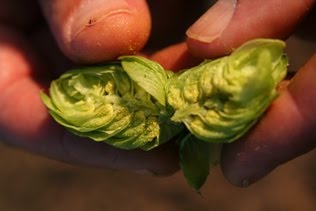
When is the optimum time to harvest hops for aroma?

How will you know when that optimum has been reached?

Do different aroma oils reach their maximum concentration at different times as the cone ripens?

These are some of the questions that drive Indie Hops to fund hop ‘maturity’ studies at Oregon State University. We are pleased to announce that the results of our first effort to wrestle with this topic will be presented at this year’s Craft Brewers’ Conference in San Francisco by OSU Professor Dr. Tom Shellhammer on Saturday, March 26th.

In late summer and early fall of 2010, Cascade and Willamette hops were collected on three successive weeks at three Oregon locations and analyzed for aromatic compounds by Gas Chromatography and Mass Spectrometry. Thirty-one different GC ‘peaks’ were identified and compared.

In a fortunate coincidence, single hop beers using some of the very same hops were brewed by Deschutes Brewing and later judged by a sensory panel at OSU. This allowed us to relate some of the lab analysis to actual flavor perception in beer, something that will be pursued more fully in subsequent projects.

The complexity of hop aroma is so great that it’s not surprising to find that each attempt to answer one question brings several more to the surface. And although this first study is too limited to produce any grand conclusions, some commonly heard notions about hops now seem to be less certain. If you’re going to CBC, consider attending Dr. Shellhammer’s presentation to judge for yourself.

Perhaps some day we’ll learn that a 5-day difference at harvest can mean the difference between a decent well-hopped craft beer and a remarkable one.

See you at the CBC.

3/21/11

Tuesday, February 15, 2011

Going Big on my 50th Birthday With Kevin Buckley’s Imperi-Ale 5.0

Whether surfing, snowboarding, mountain biking or drinking IPAs, there’s a fine line between “going big” and taking yourself out.

More’s not always better. Sure, it’s quite a thrill to land that gnarly jump or ride that killer wave, but there’s a point where raising the bar will eventually kill you. Sort of like with imperial IPAs – a bigger IBU doesn't usually translate as a better tasting beer.

With that challenge in mind, I asked my friend Kevin Buckley to work outside his comfort zone and brew a specialty “big beer” for my 50th birthday. Kevin doesn’t normally toil away making gigantic “hop bombs,” but he generously agreed to give it a go.

The marching orders: use all Oregon grown hops supplied by Indie Hops; use about 5 pounds per barrel (to match my 50th), and unleash it on the night of my roast, cold (two months hence). The name: Imperi-Ale 5.0.

Kevin brewed with our Nuggets (13.9% AA, high essential oils), Centennial (11.5% AA, also high in essential oils), and Cascades (8.5% AA) per the following schedule:

First Wort-Nugget 2#
60 min-Centennial 2#
60 min-Nugget 3#
15 min-Centennial 2#
15 min-Nugget 2#
Whirlpool- Centennial 1#
Whirlpool-Cascade 2#
Primary ferm-Cascade 5#
Dry Hop-Cascade 15#
Dry Hop-Centennial 6#
Dry Hop-Nugget 4#

Dry hopping with Nugget? We admired the pluck, but were a bit concerned. Although it’s not uncommon to dry hop with super alphas that also have high essential oil (e.g., Columbus, Magnum, Summit, Simoce), most of said oil consists of myrcene and we were worried about off flavors (cat piss, grassy or machine –yuck!). How would all those essential oils, mainly myrcene in the Centennials and Nuggets, react with the alcohol, Co2, yeast, sugars, and oxygen?

Surprise Surprise! The result was a highly drinkable, well-balanced, pleasantly fruity beer without the sharp bitterness you might expect from a hop-forward ale clocking in at 98 IBU. The 8.7% ABV proved dangerously unnoticeable, as my fired up and emboldened friends lapped it up and proceeded to pound me unmercifully. Hey, like I told my roasters: A true friend will stab you in the front! (quoting Oscar Wilde). It went quickly.

A few of the comments on the Imperi-Ale 5.0 from the not exactly naïve quaffers in the room: a mildly sweet front end with a touch of melon flavor… A clean transition to a gentle bitterness… Moves towards a citrus/spicy note nurtured by a warming bready-toasty character of malt…. Finishes with a crisp melon punch and caramel sweetness, capped by a touch of lingering bitterness…

As Kevin modestly explained: “This brew, while loaded with hops, was designed to be big yet enjoyable for all levels of drinkers. For the extreme hop heads, there are moments when the hop bitterness shines through. For those partial to red/English pales, there’s plenty of body and malt complexity.”

Thanks Kevin. You went Big and we enjoyed the ride. And thanks for experimenting with our Nuggets for dry hopping. It’s a credit to your brewing talents that you were able to land this hugely hopped beer with grace and style (in stark contrast to Mr. Solberg, who after a few hours of steady infusion fell like a Mighty Doug Fir).

Imperi-Ale 5.0 was launched last week and Kevin’s customers are loving it. There’s still a few kegs left, but you should probably beat a hasty path down to Backstreet Brewery in Vista if you want to taste this break out, all Oregon grown hops beer. Hey, to those of you who might’ve stereotyped IH as an aroma only outfit, we can go big with the alpha, too!

Roger Worthington
2/15/2011

Tuesday, February 8, 2011

Variety, Uniqueness, Consistency

Craft beer thrives in a culture of diversity and adventure. In our own little town of Portland, Oregon, as soon as we reached thirty-some breweries and mumblings of “over saturated” picked up, a dozen more breweries opened up much to the enduring gratitude of happy customers. The growing variety of beers, pubs and breweries is attracting more and more thirsty people everyday.

Perhaps more than any other arrow in the quiver of ingredients, hops cast a spell on brewers and imbibers of American craft beer, tickling the potential for variety and individualism. Their symphony of oils reaches each of us with a unique tone, the crescendo leading some to ecstasy and others to seek refuge. We continue to be amazed at how wildly different educated palates can interpret the same hop.

Last summer a focus group panel was held that illustrates these varied perceptions toward hops. A group of accomplished craft brewers from Oregon tasted a series of single-hopped beers, not knowing what the hop was in the various samples. Descriptors they used to describe the prevailing hop character, and the number of panelists who used that descriptor, are below:


Clearly, one brewer’s nectar can be another’s poison! [One guy’s fruity apple can be another’s cat pee?]

As we’ve striven to learn from brewers how they’d like to see the hop world evolve, this theme of variety, creativity and uniqueness stands out.

Our resident brewer and Brewery Ambassador Matt Sage has recently travelled the craft brewery scenes in Washington State, Oregon, Southern California and Colorado, seeking insights into what brewers are looking for in hops. His findings are as varied as his travels! Click here for a taste of Matt’s curious adventures in the world of hop flavor.

Alongside variety and uniqueness, brewers also care about consistency. After all, when we find something we really like, we want it to be consistent. What can Indie Hops do to help the hop world evolve in a way that craft brewers would like to see? Well...might as well start with variety, uniqueness and consistency!

Click here for a review of a few of the breeding projects underway at Oregon State University that we are spearheading in our quest to probe the mysteries and amplify the wonders of the noble flower.

Cheers!
JS
jim@indiehops.com
2/8/11

Good Times at Karl Strauss’ 22nd Anniversary Party

San Diego. Let’s deal with it: most of us are afraid of stouts. Not because of the taste – in fact, we recoil from the darkish, kawfeeish hell’s brew in spite of the taste. Once we get past the word’s connotation – stout, burly, thick, fire hydrant-ish – and actually taste it, all doubts tends to disappear. Like going into a scary neighborhood and coming out with a new best friend.

I admit to such a bias. Never a fan of the stouts. But then I took the leap (I was pushed) and – Eureka! – I found it. I may have graduated, but not my Darling Wife. She’s cold on kawfee. And she of course assumed dark malted beer tasted like espresso. And then there’s that whole weight thing: drink this and your buttons will pop and your bra will snap.

So it was with great pleasure – like perhaps watching a problem child graduate with honors – that I watched my bethrothed belly up to the Stout line more times than I could count. Thank you Karl Strauss: you’ve shown another lost soul The Light and The Way. And still that girlish figure!

A big shout out to my friends Chris Cramer, Matt Rattner and Paul Segura down at Karl Strauss. We were fortunate to get through the velvet rope for a sampling of KS’ latest barrel aged stouts. Paul is truly breaking out with exciting new recipes that dazzle and delight. We sipped the bourbon barrel blended and unblended vanilla imperial stout and found ourselves inside our favorite confectionaire in Bruges, aglow in the creamy warmth of chocolate, raisins, vanilla and – yes! yes! – coffee.

Turns out the DW can enjoy coffee as long as it’s buttressed with vanilla beans, malt, hops and bourbon barrel aged!

As the band played and strangers became friends and the delicious hors dourves slowly disappeared, it occurred to us that we were having a peak moment inside what amounted to an unheated industrial warehouse. The only pretense of glamour was a red carpet, which was more parody that fashion. The stark surroundings drove home the cliché that great friends, food, beer and music make a great party, not a fancy ballroom or chic nightclub.

And yet… there is talk of remodeling the Karl Strauss brewery, building out a tasting room, adding a patio, and making the brewery a destination spot. As much fun as we had in the unvarnished brewhouse, just imagine the joy of tasting KS’s finest with old and new friends around a fire pit after a walk on the beach or exhilarating bike ride. The brewery is located smack dab on one of the most popular bike routes in San Diego.

I see potential.

RGW

2/7/11

Monday, January 24, 2011

The Low Down on Simcoe®

Having trouble getting Simcoe®? You’re not alone. A ton of brewers have asked us for Simcoe®, which we don’t have, as it’s a proprietary hop owned by Select Botanicals Group, LLC, who restricts who can grow it. Our growers have not been licensed to plant Simcoe®.

A brewer in Southern California recently told me he just bought the last 3,000 pounds. I didn’t ask what he paid, but in view of the high demand and short supply, I’m sure the “spot” price was not pretty.

The scarcity of Simcoe® and the near-desperate demand prompted me to poke around. First, let’s look at the sheets. Yakima Chief Ranches,Inc. applied for the original patent in 199. They identified Simcoe® as a dual purpose bittering/aroma hop, with a hefty yield of 2300-2500 pounds per acre. The current owner of the trademark Simcoe(r) is Select Botanicals Group, LLC, of Washington.

A review of the USAHops website shows that the Washington farmers planted 237 acres of Simcoe® in 2010, up 29% from 2009. (By comparison, WA farmers planted 443 acres of Chinook, up 15%).

However, the average yield was 1,698 lbs/acre. This is a 20% drop from the year before and about a 30% decline from it’s purported average yield ( 2,300—2,500 lbs/acre). (By comparison, Chinook’s average yield was up around 8% at 1,963 lbs/acre).

I understand that Simcoe's owner has licensed three (3) farms in Washington to grow their prized invention. I'm not sure how many merchants are allowed to sell it.

It’s clear that the supply was down. A baby harvest? Pest or mildew issues? Not sure.

Why the popular demand? Let’s look at Simcoe’s chemistry:

Alpha acids: 12-14% (Chinook 13-15, Centenn. 10-13)
Beta acids: 4-5%
Cohumulone: 15-20% (remarkably low!)
Total Oil: 2—2.5 ml/100 g (huge, on par with Magnum and Centennial)
Myrcene: 60-65% (Chinook’s is 52)
Farnesene: 0% (Chinook and Centenn. “trace”)
H/C ratio: 2.1 (same as Chinook)
Storability: good
Parentage: Undisclosed (the inventor’s not telling)

Brewers have described the aroma as complex, hovering between citrusy/grapefruity and piney. I’ve read references to Simcoe® as “Cascades on steroids.” Interestingly, in Yakima Chief’s patent application, the only hops referenced were Cascade and Galena, in the context of shattering potential and shoot emergence, respectively.

So let’s say you want Simcoe® but can’t get it or don’t want to pay high spot market prices. Are there “alternatives?” Choosing an “alternative” is at best an inexact science. Do we find a cultivar with similar hop chemistry? We can’t compare parentage, as Yakima Chief’s keeping the blood lines secret. We could study key molecular markers on the Simcoe® mystery hop and on likely parental genotypes, but this would take both big time and big money.

For now, if your recipe calls for Simcoe® but you can’t get it, you might experiment with blending hops. We haven’t done the science, nor have we played with pilot brews ourselves, but our hunch is a blend of Chinook and Horizon might do the trick (Horizon for bittering only).

In our view, the spot market spike and scarcity of Simcoe® points up the need for diversification. Brewers should have access to suitable hop alternatives. Growers should have access to rhizomes without paying restrictive licensing fees. Scientists should have access to the parentage, both to develop alternatives as well as to validate disease resistance assessments.

Of course, the shortage also underscores the need by brewers to contract long term with merchants or growers for must-have varieties. In 2011, we will be harvesting our first crop of both Chinook and Horizon. We’re naturally very excited, as over the last few decades both workhorse hops have been the exclusive province of Washington growers.

Roger Worthington
1/24/11

PS. For more information on Simcoe®, click on:

http://www.yakimachief.com/hopvarieties/simcoeyc014.html

To compare Simcoe’s hop chemistry with other cultivars, click on:

http://www.indiehops.com/haunoldpub-privchart.asp and
http://www.indiehops.com/aroma_variety_survey_chart.asp

To read Simcoe®’s patent application, click here

For more information of Select Botanicals Group, LLC, see http://wa.14thstory.com/select-botanicals-group-llc.html

Click here for the trademark ownership.

Thursday, January 13, 2011

Hobby Hop Farmer Jim Spencer Mixing Up the Medicine

Here’s a fun story.

My neighbor up in Madras, Oregon, Jim Spencer (that serene fella to the right), read my blog about using a French Press to extract more hop juice and decided to give it a go himself. Turns out Jim is a gentleman hop farmer with an abiding passion for the noble flower.

I’ve learned that Jim’s growing Cascades, Magnum, Newport, Nugget, CTZ and Chinook – the higher alpha varieties – on just under one acre. You got to love that Oregon pioneering spirit.

Anyway, Jim took my experiment to the next level. Using Nugget cones from his own yard, he’s been brewing up a hop tea and adding it to his favorite IPA. Like me, he’s drawn to the potential power of the hop to relax the nerves and fight off free radicals. He warns that drinking too much of hop tea in the morning can render you nearly comatose (but happy) by noon (well, it might make you happy, not your boss).

Like any dedicated lab rat, Jim’s committed to his playful tinkering. As soon as he finds the right balance that relaxes without tranquilizing, we’ll let you know. By the way, we’re having fun here so if you’re a snoop for the FDA hell bent on scolding exuberant hop heads, please chill out (at least try).

----------
From: Jim Spencer
To: Roger Worghingon
Sent: January 05, 2011
Subject: Home Hop Press Experiment

Roger,

Just got a French Press Coffee Maker for Christmas. Decided to try your Home Hop Press Experiment after reading your article from the October Issue of your blog. It occurred to me that HEAT was needed to release the oils and the rest of the goodness locked up in the hops.

I put about 1/4 cup of whole hop cones (Newport) in the French Press and added 1 cup hot water (about 180F) and let it steep for 6-10 min. Then I strained it [about 4-6 ozs] into an Imperial Pint glass and topped it off with a 12oz Pale Ale (Homebrew).

The result was surprisingly drinkable. The color was that of a pinkish Hefewiezen and the taste was strongly citrusy but still had some "beer-like" qualities. With a little tweaking of the Hop-Tea to Beer ratio I think it may make a decently refreshing summer beer...like a raspberry wheat type of summer beer.

But, I think the real value of this concoction is as a Health Cocktail. Like you, I'm convinced that it is full of concentrated levels of anti-oxidants, anti-microbials, anti-cancer agents, etc, etc. I've had one of these drinks each of the last 4 nights and I've got to say I've been sleeping great, too.

I have no idea how to fit a giant French Press type plunger on a fermentation tank...but I have found a tasty sleep-aid and I may just be protecting myself from cancer at the same time.

Thanks for the tip. Hope this helps.

Jim Spencer
Madras, OR

Wednesday, January 12, 2011

Competition Good for Hops, Farmers and Brewers

Attention Craft Brewers:

I hope this note finds you in a robust spirit as we settle in to the new year. Fortunately, we have much to be upbeat about – craft brewing is one of the few bright spots in an otherwise dismal economy. Every day it seems we’re hoisting hoppier beers and welcoming more happy converts.

As you plan your future hop needs, please consider Indie Hops.

• Our prices may not be the lowest you can find but they will be competitive enough to not have a significant effect on the hop portion of your COGS. If it's more, it will be a tiny fraction of the $10 more per lb. you were paying just recently and it's a fair price to pay to insure that everyone in the supply chain is healthy so that the hop supply stabilizes.

• After several years of selling hops at a 400% markup, the de facto hop cartel in Yakima can afford to offer new contracts virtually at cost in order to keep you dependent on them when the next price cycle comes along. Yes, there was a tight market in 2008 and it is reasonable that brewers without contracts would have to pay more that year. However, the very next year 7,000 additional acres of hops were put in and there was no longer a shortage to justify the long contracts at record high prices. Having few alternatives, you had little choice but to agree to lopsided terms.

• Do you want to reward the Yakima merchants for this behavior by giving them all of your business now that spot prices are low? Unless Indie Hops and others are around to offer competition the next time the supply tightens, you will once again have no choice.

So having said all that, I politely encourage you to continue to diversify. Buy from your current suppliers. Buy directly from farmers. Buy locally. Buy from overseas. And buy from the new guys with the lightly processed fresh pellets who believe in promoting publicly owned cultivars – Indie Hops. Spread the love, lower the risks of controversial shortages, promote hop and hop farmer diversification, and make a new friend with a fresh spirit.

Keeping competition alive will be as good for the hop industry as it has been for the brewing industry. We appreciate your support.

Cheers!

Roger

Available hops: http://www.indiehops.com/pdf/IH_Order_Form.pdf

2011 crop: http://www.indiehops.com/pdf/IH_contract_pricing.pdf