Showing posts with label Willamette. Show all posts

Saturday, May 19, 2012

What's Cooking in the USDA's Hop Kitchen? A Conversation with Head Hopster Dr. John Henning


Dr. John Henning
In Part 1, we talked about a proposal for creating a royalty-sharing program that could help strengthen the public’s hop breeding and research program.

In Part 2, we’ll take a look at what’s happening down in Corvallis at the USDA-ARS hop breeding and genetics program, which is run by Dr. John Henning. Dr. Henning has been managing the hop program since 1998 (CHECK THIS!).1996.

I called up Dr. Henning who was kind enough to give me a snapshot of what’s cooking. First, and this is cool, Dr. Henning reported that despite a shrinking budget he has about 50 crosses and 40,000 seedlings for this years breeding nursery. Within that “gene pool” he has a “seedless” Perle derivative, as yet unnamed, that has shown promise. Because of a downey powdery mildew invasion in the USDA greenhouses in Corvalliswhere his material was being evaluated a few years ago, most of his genetic material has been moved to WSU greenhouses in Pullman,located in Washington.

Dr. Henning is very excited about the “in kind” support the USDA has been receiving from farmers. The partnership has allowed him to “ramp up” the intensity of his benchwork research on crossing, propagating and selecting promising hop lines, without having to manage greenhouse and field trial operations. Unlike the Indie Hops-OSU breeding program, Dr. Henning’s focus is on both aroma and super alpha development, no small order.

I was curious about the process for “checking out” public and experimental hop varieties from the USDA germplasm repository in Corvallis. The repository contains clones of about 200 public varieties and 100 experimental lines. To be sure, unlike a public library, you can’t just walk in ask for rhizomes for your backyard garden. The purpose of the repository is to collect, preserve and distribute hop material to foster research.

Here’s a few questions I posed to Dr. Henning about the “in kind” support paradigm, the inside scoop on his Perle brainchild, and the stuff that keeps him motivated and up at night.

RGW: I just want to make sure I have this down right. The USDA does not supply germplasm to farmers for testing; rather, you provide rhizomes, or plantlets to select farmers who then propagate and grow them out? Does anyone outside of the parties who sign the MTA [Material Transfer Agreement] have knowledge of what's being tested or where?

JH: The USDA-ARS breeding program provides rhizomes of experimental lines directly to a grower or growers who are under contract (Material Transfer Agreement) to grow out said experimental lines for “On-Farm trials.” These growers are chosen by the respective State Hop Commissions (OHC and WHC) and Hop Research Council (HRC) to perform this function. Funding is typically provided the grower(s) to recompense them for their costs—in most cases this is around $6000 per acre. In all cases, State Commissions and members of Hop Research Council (HRC )(FOOTNOTE1) are fully aware of what experimental lines are put into those trials.

HRC members and State Commissions have made specific requests regarding which experimental lines they would like to see sponsored in “On-Farm” trials. USDA-ARS can also suggest experimental lines if not included on the list of lines HRC or State Commissions select for advanced testing. Finally, The USDA-National Clonal Germplasm Repository does not provide any experimental lines to growers, merchants, brewers or other researchers unless specifically requested by myself. Typically, this is done in cases where researchers from different countries and breeding programs have agreed to germplasm exchanges of important material. It is in this fashion that USDA-ARS was able to obtain true dwarf hop germplasm for genetic and breeding research—by agreeing to provide pollen from USDA-ARS hop male lines that were not released as well as a few publically released hop varieties such as Teamaker and Newport.

RGW: So you don’t hand pick the farmers for testing experimental lines?

JH: Correct. I don’t pick the growers. I use both WA and OR growers and these growers are selected by their respected State Hop Commissions and the HRC.

RGW: Can you tell us more about the Triploid Perle you’re working on? Has anyone pilot brewed with it?

JH: The information on Triploid Perle is contained within the HRC yellow book reports. The triploid Perle line is a true seedless hop, which is highly desirable as Perle is normally a prolific seed producer. It has somewhat of a higher alpha at 11-12 % with beta acids around 4- 5 %. Yields for this line are tremendous—potentially on par with some of the “supers” that are out there. In addition, it’s high in essential oils that give floral and citrus notes. Finally, it has oil content exceeding 1.5 ml per 100g of dried cone. OSU’s Fermentation Science program is the only “micro brewery” to pilot brew with it. I’m sure others would love to experiment with it but I only have had hops from a single plant at the moment. After tasting the single hop brew that Tom Shellhammer (OSU) made, several breweries have expressed an interest in it. Unfortunately, I went from a single hill to multi-hill plots in 2011 and plants were in their baby year last year. There should be sufficient hop this upcoming harvest for multiple pilot brews by HRC members. It’s being grown on 40 hill plots in both Oregon and Washington. These plots are being sponsored (financially) by HRC.

RGW: You read about the number of Oregon hop farmers declining over the past few decades. What are your ideas for keeping the Oregon hop industry vibrant?

JH: My mandate from Congress is to for keep theing USA hop industry vibrant, not just Oregon. With that in mind, my best contribution would be to continue developing superior germplasm and cultivars that allow US growers to outperform other nations and make a finished beer that tastes better than beer made from hops from other regions of the world. With this said, Oregon growers have been particularly hurt by the surplus of ‘Willamette’ that was grown in the past and which was stored. This surplus has resulted in a significant drop in acreage (6000 to 3000) that has not been replaced by another line yet.

As you know, Willamette is susceptible to fungal pathogens and a replacement is needed for growers and brewers. The USDA-ARS and WSU are working closely with HRC brewery members to develop and release a disease resistant, higher yielding aroma hop as a replacement for Willamette. It is highly likely that a new public hop variety (Such as Mt. Rainier or the Triploid Perle) will be chosen to replace Willamette when inventory of Willamette is used up. If this occurs, we would most likely see a dramatic improvement and vibrancy of the Oregon Hop industry, as well as in Washington and Idaho (both of which groew Willamette).

RGW: What research topics most invigorate you? What are you most passionate about? What's your "dream legacy?"

JH: That’s a tough question!! I’m multi-faceted in what invigorates me and gets me passionate. I would love to have the legacy that Dr. Haunold obtained by developing superior hop varieties that are grown to a great extent throughout USA. At the same time, I’m striving towards developing molecular marker systems that would enable breeders to be more precise in selection as well as speed up the selection process. Finally, I’m striving towards working with other renowned hop scientists to completely sequence the hop genome. To achieve all three of these goals would be my “dream legacy.”

RGW: What's the story on Mt. Raineer, which you released in 2006?in 2008? Who's growing it? What was your target or objective in developing the cross? What was the production in Oregon on Raineer last year, if you know?

JH: Mt. Rainier is a fine hop that hasn’t taken off yet. I see it as a victim of outside circumstances—mainly issues of supply and demand in nature. Just prior to the release of Mt. Rainier, there were two years of crop failures. This was followed by a dramatic increase in planting new hops (including Willamette here in USA and Halletauer Mittelfrue in Germany). The result of this dramatic increase in hop plantings resulted in a significant oversupply of hops and hop products. Mt. Rainier was released right after this huge oversupply of hops occurred and there was very little demand for hops--new or old. The production and distribution of Mt. Rainier was also hampered by the appearance of hop stunt viroid in 2008. To make a long story short, it was entered into the Clean Plant Network as soon as possible and if I’m not mistaken, will become available this year for limited distribution of cuttings. While it was in on-farm trials at John Annen’s [FOOTNOTE 2] farm (5 AC), it was distributed to several craft brewers.

From the limited responses I received back, it was viewed as an excellent hop on par with, and similar to, true Halletauer Mittelfrue grown in Germany. Unfortunately, there was a huge oversupply of Halletauer Mittelfrue that was being sold for ~$1.50 lb and brewers saw no reason to pay $3.50/lb for Mt. Rainier when they could buy Halletauer for $1.50/lb. When Mt Rainier was growing in the 5 AC plot at John Annen, he regularly obtained 12 bales per ac. He barely had to spray for downy mildew and never had to spray for powdery mildew. My target in developing this hop variety was one of developing an aroma line that was somewhat higher in alpha acids and was disease resistant with excellent yields and good pickability.

RGW: What is your worst fear about the future of Oregon hop f harm farming -- in terms of disease or pest invasion? What are you doing to anticipate and prevent major catastrophes? (Now that's a tall order!)

JH: In some sense, it’s already occurred. The hop stunt viroid has the potential for making hop farming extremely difficult both here in OR as well as WA and ID.

Furthermore, the potential advent of hop powdery mildew races that are “male AND female” as opposed to “either male OR female” and capable of mixing up genes from several races in the Pacific Northwest may make breeding hop lines resistant to powdery mildew extremely challenging. What this means is that new races of powdery mildew can arise quickly and overcome current plant resistance in hops found in such lines as Nugget or Newport.

Currently, I’m working on identifying molecular markers that will aid in selection for experimental lines that are resistant to both powdery and downy mildews. Once identified, these markers will help speed up the selection process as well as increase the accuracy of selection. I work closely with Dr. David Gent (USDA-ARS Plant Pathologist) in screening new breeding material for experimental lines that are resistant or highly tolerant to both pathogens. This is time-consuming, labor intensive and expensive doing things the old fashioned way—inoculate with the disease and visually chose resistant lines. We’ve had some success in developing new experimental lines that appear to have better “resistance packages” than currently grown varieties. These lines are working their way through the “breeding cycle” which can take upwards of 10 years before public release.

RGW – Thanks John. You’ve got a full plate. Naturally, I’m worried that hop research is being underfunded. I’ll take a look at the public funding of table and wine grapes, as an analogue to hops. My cursory research shows that the USDA-ARS budget for grapes has actually been increasing over the past few years, and is now up to over $15 million, with $2 millon dedicated to grape breeding and genetics alone. As we discussed in the last blog, the total USDA-ARS budget for hops is around $750,000, with only a fraction of that available for actual programmatic research.

I think it’s time to apply political pressure. A hearty collection of diseases could wipe out entire crops, and we haven’t even talked about pests. To keep up with an ever-changing battery of pests and diseases, we need a strong federal hops research program. And the last thing this industry needs is a concentration of breeding, growing, and processing muscle in one place. Wine grapes, for example, are grown in dozens of states and the USDA allocates funding to research facilities in 7 states.

More to come.

RGW
May 18, 2012

FOOTNOTE 1. Hop Research Council members include two craft brewers, Boston Beer and Sierra Nevada, and “industrials” such as Anheuser-Busch-Inbev, Heineken and Miller Coors. The HRC hop dealers include: Hopunion, Haas, Steiner, and Yakima Chief.

FOOTNOTE 2. John Annen is the Chair of the Oregon Hop Commission, which was created in 1964 to protect, serve and enhance the Oregon hop industry, as well as a hop grower and owner of Annen Farms.


Thursday, March 22, 2012

Columbia Debut Delayed as Meridian Steals the Show


The Story of the Discovery of a New Oregon Hop

Oh dear.

Remember Columbia? The “sexy” sister to Willamette unceremoniously banished years ago to the basement of hop history? Remember how we gleefully announced that we had resurrected this beauty? That we’d be the first to grow it commercially? And that our craft friends couldn’t wait to set her free?

Separated at Birth, Indeed
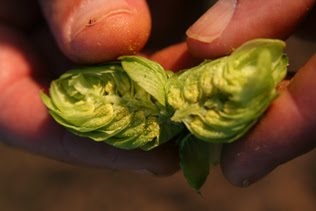
We originally reported that the hop on the left
was "Columbia" and the one on the right
was it's sister, Willamette. Turns out our
"Columbia" was actually a new plant,
which we've coronated as "Meridian
Well, we grew her, and dried, baled, and pelleted her, but a funny thing happened on Columbia’s walk down the red carpet. Since nobody had ever “dated” her before, we didn’t quite know what to expect. We suspected she’d be a beauty, with a slightly higher alpha than her floral sister, but this Gal quite simply dazzled us beyond our wildest dreams.

One by one we brought in some of the finest snouts in the land to give her a rub and sniff. It was fun to watch. We’d fill a table with several fresh varieties and our guest would do the dance, concentrating hard, earnestly associating the aroma with descriptors. Without exception, they’d take a whiff of the unlabeled “Columbia” pile and stop in their tracks, arrested, if you will, by the stunning uniqueness. We began hearing words like “Meyer lemon pie.” “Fruit punch.” “Unique.” And “wow!”

The evidence began piling up. When we harvested her, the drying room at Goschie Farms bloomed with a strikingly unique and pleasant aroma. We suspected she’d be different than Willamette, but this different? Something was …. off, in a good way.
We sent her off for a chemistry profile. More and more brewers who sniffed her were amazed at her uniquely fruity aroma. Could it be? We waited. The results came back. Per the literature, we expected Columbia’s alpha-beta ratio to come in at 2:1. But, at 1:1.5, this spunky girl flipped the ratio. She wasn’t just a shade different, she was looking like a brand spanking new leaf!


What's in a Name?
That which we call a Columbia
by any other name, say,
hmmm, "Meridian," would smell
as sweet. With apologies to Bill Shakespeare.
We ran more chemistry. It became evident that she was not Columbia. But what was she? The only pedigree that came close was Glacier. But a defining characteristic for Glacier is her super low cohumulone, at 12%. Compare that to the mystery girl’s CoH, at 45%. They didn’t match.

We ran through all the databases, looking for a match. The conclusion was inescapable: nothing matched. We had found a new hop, a strikingly beautiful new hop that packed a powerfully unique new aroma. We called our customers who had ordered Columbia and with a mixture of excitement and trepidation explained that what we thought was Columbia wasn’t Columbia. Thankfully, our customers shared our enthusiasm for this new find, and offered congratulations.

Suddenly, we had a million things to do. We had printed up a bunch of t-shirts that showcased the debut of Columbia, the famously forgotten Sister. We had to hold on to those. We had to delay putting in new acreage until we could learn more about the agronomy and disease/pest resistance of the new plant.

And we had to give our mystery girl a name. That wasn’t hard – we discovered the plant on Goschie Farms within a few meters of a country road named “Meridian. “ Meridian – a navigational term, an imaginary circle on the planet passing through the North and South poles, but also used in conversation to mean the “zenith” or “summit.” Hmm. We like that. Wherever you are, when you’re drinking a beer hopped with Meridian, you’re approaching the zenith or summit of flavor.

Back to the Basement,
Dear Sweet Hidden Sister
The good news is that when Columbia finally debuts,
we've got a boatload of commemorative t-shirts ready to roll!
As of this writing, the brewer feedback continues to pour in. One brewer has used it in a single hop lager beer, which he described as “clean” and “crisp” with a “refreshing sweet lemon character.” Meridian has also raised eyebrows and oxytocin injections (Ok, made that up) in a wide range of ales, from pales to dark roasted malt “winter seasonals.” It’s reported to play well with Belgian yeast and has a way of amplifying the zesty zing of weissbiers.

We’re excited over here, about excited as anyone should be allowed to get over the discovery of a “sexy” new hop plant. We want to thank Gayle Goschie for her well-intentioned but fortuitous “mistake,” Dr. Shaun Townsend who helped us determine that “Columbia” wasn’t Columbia, and all of our friends in the craft brew world who basically said we don’t care what you call it, we just want more of it!

At the same time, on a somber note, we’re mindful that poor Columbia, as mighty and strong and beautiful as we know she is, will have to wait another few years for her big night in the spotlight.

RGW
3/22/12


In Pursuit of Columbia
Dan Kopman of Schlafly Beer in St. Louis
was our first customer to order Columbia. Shown here,
on the left, with Gayle Goschie, R. Worthington and
Matt Sage (left to right). Goschie Farms, July 2011.

Friday, August 19, 2011

Columbia Finally Gets Her Limelight


Oregon Rain!!
Roger and Dr. Al Haunold
performing the Willamette
Valley Hop Dance, Goschie Farms.
"These are my babies," beams
The People's HopMeister.


Introducing, finally, after being banished by the King of Beers in the hop basement for two decades, the fragrant, the durable, the the unsung sister of the Queen of Oregon Hops, the soon to be mighty Lovely Miss Columbia!!  
We've written previously about our efforts to resurrect Columbia, the forgotten sister of Willamette. To recap, back in the Summer of Love, Dr. Al Haunold was asked by Bud to breed a hop similar in character to Fuggles. Several years later, early in the Disco era, he presented two new cultivars, Columbia and Willamette.

Bud's team of six brewers evaluated pilot beers using the new little "Fugglish" darlings, and all six selected Columbia as the winner. Rank, however, has its privileges. Along comes their boss, Bud's head brewmaster, Frank Schwaiger. Frank zeroed in on the chemistry. Columbia had a slightly higher alpha acid profile than Willamette (8-9% AA vs. 5-7%, respectively), but otherwise the oil profile was virtually indistinguishable. Our German born Brewmeister prophesied that the US consumer would never go for a higher alpha acid hop (a prediction that ranks right up there with Henry Ford's lawyer advice that the automobile was simply a fad and the horse was here to stay).


The result: Bud chose Willlamette, which went on to fame and fortune, and Columbia never saw the light of day. Until now. Yesterday, on a brilliant, sunny day in the Valley, we walked the hopyards at the idyllic Goschie Farms with Columbia's proud papa, Dr. Al Haunold. Al last saw big green Columbia cones dangling some 40 years ago. Needless to say, he was happy to see Willamette's slightly bolder sister finally get her moment in the sunlight.
Separated at Birth.
Pointy Columbias, on the left,
and plump Willamettes, on the right.


And so are we. Columbia and Willamette share the same parents and yet they sport amazing differences. Take a look at the picture to the right. The Columbia cone is longer and narrower with spiked bracts (granted, this is approxiately 2-3 weeks before harvest). Willamette is fuller, rounder and plumper. As mentioned, the chemistry profiles are slighlty different. As for aroma, based on an in-the-field rub & sniff, both have superb aroma, but the Columbia has a subtle "lemon twist" at the finish that seems to trigger an eye-lid flutter response and cheeky giggle.  

Welcome to the light, Miss Columbia. May you enjoy many more moments in the sun as we, the beer drinking public, finally get to revel in your glorious bounty.

Roger Worthington
8/19/11


A Man Outstanding in His Field.
Here he is -- the man who
brought us 23 public hop varieties.
Dr. Al Haunold, surrounded by Columbia hops.


Monday, March 21, 2011

Hop Harvest Time: When and How Do You Know? OSU’s Tom Shellhammer Has A Clue

When is the optimum time to harvest hops for aroma?

How will you know when that optimum has been reached?

Do different aroma oils reach their maximum concentration at different times as the cone ripens?

These are some of the questions that drive Indie Hops to fund hop ‘maturity’ studies at Oregon State University. We are pleased to announce that the results of our first effort to wrestle with this topic will be presented at this year’s Craft Brewers’ Conference in San Francisco by OSU Professor Dr. Tom Shellhammer on Saturday, March 26th.

In late summer and early fall of 2010, Cascade and Willamette hops were collected on three successive weeks at three Oregon locations and analyzed for aromatic compounds by Gas Chromatography and Mass Spectrometry. Thirty-one different GC ‘peaks’ were identified and compared.

In a fortunate coincidence, single hop beers using some of the very same hops were brewed by Deschutes Brewing and later judged by a sensory panel at OSU. This allowed us to relate some of the lab analysis to actual flavor perception in beer, something that will be pursued more fully in subsequent projects.

The complexity of hop aroma is so great that it’s not surprising to find that each attempt to answer one question brings several more to the surface. And although this first study is too limited to produce any grand conclusions, some commonly heard notions about hops now seem to be less certain. If you’re going to CBC, consider attending Dr. Shellhammer’s presentation to judge for yourself.

Perhaps some day we’ll learn that a 5-day difference at harvest can mean the difference between a decent well-hopped craft beer and a remarkable one.

See you at the CBC.

3/21/11

Monday, September 6, 2010

Harvest Time! Weird Scenes Inside the Green Gold Mine.
Hoppy Readers: Please join me on a quick tour of Goschie Farms during the hop harvest in late August, 2010.


Whole lotta shaking going on! From the back of the truck workers fasten the hop heavy bines to a conveyor and then sent through a gauntlet of thrashers which strip the cones from the bines, sidearms and stems. The action, sights and sounds are both deafening and invigorating. More twists, turns, drops, jolts and jumps than the corkscrew coaster at Six Flags.

Matt Sage, above, embracing Gayle’s Green Bounty. Normally Matt’s going 100mph with his hair on fire. I’ve never seen him this cool and collected. Must be the opium in those Willamette hops. From the picking room, the hops are conveyored over to the kiln and drying rooms.

Here the green gold falls from the belt like fruit from a tree onto the drying room floors. Goschie Farms has six hot air blowers which heat the raw cones up to about 140 degrees F just long enough to leave about 10% of the cone’s original moisture.

Check out the sea of green above. The drying room is in a coverted barn that’s been the heart and soul of Goschie Farms for decades. The picture doesn’t show it, but the room is very, very humid. Poke your head in there and your glasses instantly fog up.


Handcrafted hops. We like to talk about our hops are grown with Tender Loving Care and processed with attention to quality over quantity. Here’s a worker who meticulously culls from the hop piles before drying any and all leafs, branches or other debris. A labor of love.

Again, here’s the normally peripatetic but now fully sedated Matt in full hop zen mode. “If you find yourself floating in a sea of green, close your eyes , relax your shoulders, and let your mind open up. You can hear the hops chanting: brew me, brew me, brew me,” says Matt.


Glory be to Gayle in all her hop glory. Gayle Goschie, second from left, flanked by intrepid hop travelers, from left to right, Dan Kopman (Schlafly), Yours Soberly, and that ball of fire, Matt Sage, at the base of Mount Willamette.

Fruits of Labor. Here’s the end result: densely packed 200 lb bales of hops. Bales are then trucked about 3 miles down a flower strewn farm road to Indie Hops clean, green pellet mill, where Captain Jim Solberg awaits in the catbird of his forklift, ready to offload the bounty into our cooler, where the oily cones are frozen down to 26F. A few days later they’re converted into big fat oily pellets before being packaged in oxygen purged foils and sent right back into the cooler awaiting delivery to your kettle.

Roger Worthington
9/5/10

Thursday, August 26, 2010

HopTalk with Al Haunold, Part XI

Freedom Hops: The Case for Public-Private Breeding Partnerships

Those who know me understand that I tend to fixate. I get the sandy grain of an idea, apply loads of constant pressure (with maximum compression around 3 in the morning.) and either a blood vessel bursts or out pops a pearl.

Here’s my latest pearl in process: the need for public-private hop breeding partnerships.

Here’s what started the itch. I was perusing the Strategic Plan of the Hop Research Council (1998, updated in 2007). By way of background, the HRC consists of a few larger brewers and all the usual merchants in Yakima. These are the insiders who have a tremendous influence on the direction of how public research dollars are spent. They also assess themselves certain fees and make additional money from HRC available through research grants.

Now, everybody knows that I think the world of Dr. Al Haunold, an extraordinary public servant I’ve heralded on this blog as “the People’s Hopmeister.” After escaping the Nazi War Machine and emigrating to the US, eventually my Austria-born mentor came to work at the USDA in Corvallis where from 1965 to 1996 he took the lead in releasing to the public over 20 new hop varieties.

Twenty! For Free! Al didn’t patent those inventions. He never saw a dime from any royalties because there were no royalties – not then, not now. Neither did Uncle Sam, nor anyone else on Al’s team of public breeders. Anybody can get access to rhizomes for hall-of-fame US varieties like Cascades, Willamette, Nugget, Liberty, and others – all the hopwork of our Nation’s No. 1 Hopmeister. Anyone can get ‘em, and anybody can grow ‘em.

Al retired in the late 1990s but his final collaborations were not released until the early 2000s, to wit: Newport and Mt. Rainier (both crosses made by Al in 1994), Horizon (cross made by Al in 1970), and the low-alpha Teamaker. By the way, Teamaker’s roots go all the way back to 1970. The brewers were not keen on it because it contained virtually no alpha acids. But his technicians loved it for brewing hop tea.

Since then – the early 2000s -- not a single variety has been released. What happened? Did the USDA lose its edge? Did they surrender? Or did they just in fine George W. Bush fashion hand over the keys to the candy store to private industry?

To answer that, let’s go back to that HRC “strategy” statement that has so jarred me – a statement which in truth prompted me to get into the game and to sponsor an aroma hop breeding program at Oregon State University.

Here it is, verbatim, from the HRC strategic plan (click here to read the entire text).

"While varietal development is a critical requirement for the continued success of USA hop growers, there is some concern that public breeding programs should not be involved in the development and release of varieties."

Huh? What’s so egregious about public servants serving the public? Who voiced this "concern"? Private breeders who saw an opportunity to fatten up with their snoots in the public’s trough? I asked Al whether there was any fuss about him taking his work too seriously, that is, depriving private breeders of their chance to make a buck on the public’s dime.

Al shrugged off the strange insinuation. "No, I wasn’t aware of any concerns. We didn’t start seeing any private breeders in the US until the mid 1980s when the laws for patenting agricultural products became more lenient. Before then, I actively worked with brewers, farmers and merchants, and we all got alone fine." With stellar results.

The HRC statement continues:

"Several private breeding programs actively work towards developing and releasing public and proprietary varieties grown with the support of a marketing system that helps growers sell their product on the world market." (Italics added).

Private breeders release “public” varieties? Well, that’s a new one. Al just had to laugh. “That’s an oxymoron. A private company can’t make a public release. I don’t know what they’re talking about.” Aside from this nonsense, the meaning is clear: the merchant-big grower-breeder industrial complex has set its sights on controlling the world market. That hop hegemony begins with patenting varieties and granting licenses to selected growers. An excellent strategy for controlling the price and supply of US hops.

It gets better:

“In almost all other crops, public breeding programs no longer serve as the major developer of varieties but do serve as developers of germplasm containing a specific trait… Germplasm developed by public programs is then utilized by private breeders for use in the development of superior varieties – the better the germplasm, the better the varieties that are ultimately made.”

Whoa doggies! First, the phony argument that “everybody’s doing it.” Second, no attempt to proffer evidence that the public is hurt by an aggressive, efficient and amazingly productive public breeding program. Third, the cavalier way in which the privatizers skip over any ethical issues and swinishly assert that the fruits of the public’s labors is their god-given birthright.

“I disagree,” Al offered modestly. “If the public program develops the tools that help us breed superior varieties, then the public should continue to be involved in bringing new varieties to market. In fact it’s more efficient, as the tool makers generally know best how to use those tools in the field.”

What does this mean for Al’s legacy of public service? “Well,” Al pondered, “it’s appears to have been ruined by the pursuit of profit. The private breeders smelled the money. They want the public to subsidize the creation of the tools – the germplasm, which can select for higher yields, disease resistance, etc – but not share anything in return. They want to restrict access by farmers. That goes against everything I worked for.”

The privatization model kicked in about the time Al retired (nice send off, boys!). How many aroma varieties have sprouted since then? Amarillo? Well, that’s an aroma, but it wasn’t the result of a private breeding program—the Gamaches found it on their farms and trademarked it, which means only they or their chosen few can grow it. Ahtanum? It’s relatively recent, but we don’t know much about its parentage. Citra is a recent privately developed hop, and by all accounts it’s a home run. But we don’t know much about where the germplasm came from. Was publicly owned germplasm exploited? If so, did the patent owner agree to share any royalties with the public?

And that’s the point. There is absolutely nothing wrong with private breeding. It should be encouraged. It’s risky. It’s expensive. It’s time consuming (8 – 12 years on average). As long as there is robust access to public varieties, the profit margin on any new variety is a matter of speculation. And any breeding mission will necessarily involve brewer feedback, just as Citra did with Sierra Nevada and Deschutes, to name a few.

The wicket gets sticky when private breeders utilize public germplasm, develop a “new” variety and then attempt to patent it for their own personal gain without sharing the fruits. Since patent applicants generally insist on keeping secret their formulas, recipes and designs, they jealously guard the pedigree of their plants like the proverbial rich ugly old maid and her silver spoons.

How are competitors going to know what’s off limits? And how does permanently restricting access to varieties by farmers, growers and other merchants help grow the craft beer industry anyway? And think of the potential for corporate espionage: it’s not inconceivable that breeders will raid USDA germplasm depositories before the cell-lines are publically released. (See the History of CTZ, here.)

That’s one big reason why Indie Hops funded the aroma hops breeding program at OSU. Public hop breeding, especially of aroma varieties, had essentially died not too long after Al retired. Our goal has been to empower OSU to invent, invent, invent. With inventing comes ownership. With ownership comes the right to impose reasonable conditions. With conditions comes the potential for royalties. With royalties comes a predictable revenue stream, a big chunk of which can be re-invested back into a public-private program.

The death of public hop breeding programs, we believe, is not only a shame, it’s a punch in the stomach to the work and legacy of The People’s Hopmeister, Al Haunold. Indie Hops stepped in after InBev/AB pulled out to fund a first-ever aroma hops breeding program in large part to continue Al’s pursuit of hops.

Does this mean we believe we are entitled to complete ownership of any new hop “invention?” Absolutely not. We believe in sharing. We look forward to executing on a public-private model that exacts sweat, skill, equity and labor from each stakeholder and commensurately rewards them while also serving the hop growing and hop-loving public.

Roger Worthington
8/26/10

Monday, August 9, 2010

Indie Hops’ Open House: A Celebration to Usher in the 2010 Harvest

HUBBARD, OR. In the heart of Oregon’s hop country, Indie Hops unveiled its clean, green pellet mill to over 100 craft brewers, hop farmers, OSU and WSU ag scientists and even a few of our competitors last Friday. After plying our guests with BBQ and beers, we cranked up the space age mill and it didn’t blow.

It did, however, to the delight of all, convert a bale of Cascade hops into big, fat, oily Type 90 pellets. As one brewer commented, “They kept crowing about their pellet die temp being under 110F and they delivered. We gunned their pellets at 106F.”

Special guest Congressman Peter DeFazio (D-Or), himself an avid home brewer, delivered a rousing speech to the faithful in which he lauded craft brewing as “a bright spot in an otherwise gloomy economy.” Rep. DeFazio made no bones about it: he’s proud to help nurture a growing industry that generates thousands of jobs at a time when the largest brewer in the US is foreign-owned (InBev/Bud).

It’s well known that Oregonians tend to support their own. Almost 40% of the beer brewed in Oregon is consumed within the state – a testament to brand loyalty as well as customer sophistication. And small in-state breweries own about 11% of the market share in Oregon, the highest in the US.

As Jim noted in his opening remarks to the faithful, "Oregon has it all. We’ve got the soil, water and climate. We’ve got some of the best brewers, the best hop farmers, and the smartest hop scientists in the world. And now Oregon has its own hop processor and we pledge to rise to the same standard of excellence that you have set."

Of course, even the best aroma hops terroir has it’s hiccups. This season was a wet one in the Willamette Valley. The rainy Spring finally did surrender to the sunny skies of Summer, but only recently. (By the way, aroma hops thrive in cooler weather). Insect pressure has been light. Mildew was a potential threat but it stayed manageable. Aphids never posed a serious threat and, thanks to cooler temperatures, the spider mites were kept at bay. The cooler summer has allowed our beloved cones to achieve their iconic plumpness.

The scuttlebutt among the Oregon farmers is that, thanks to the surge in sunshine, we should have a decent – but not banner --harvest, although for certain cultivars it might be delayed about a week. The following is a snapshot of the anticipated harvest for select varieties:

US Tettanger -- August 16-18th
Centennials -- August 18-20th
Willamettes -- August 23ish
Sterling -- September 3-6.
Cascade -- September 6-8th.
Mt. Hood -- 1st week September

As the venerable Val Peacock, Ph.D, recently advised in The New Brewer (July/Aug 2010), brewers are advised to visit the farms from which they purchase their hops. We agree – and we’ll add to that sage advice our own admonition that you ought to get to know your pellet millers and walk their shop. At Indie Hops, we’d be happy to arrange for you to visit the Goschie and Coleman hopyards.

Check for yourself the quality of the hops, the cleanliness of the farms and machinery, the timing of the harvest, the status of any mildew or pest problems, and the operation of the drying rooms. After a tour of the hopyards, we’d be pleased to escort you over to our nearby plant and perhaps run a few bales for you. We’ll provide the earplugs, but even though we tend to get carried away with our pellet design and quality, we’ll ask in advance that you not insert them until we flip the switch.

Thanks to everybody for joining us in the celebration of Oregon’s first pellet mill. We’re very pleased to join the craft beer revolution and we appreciate your support and feedback. Special thanks to Bridgeport, Lucky Labrador and Full Sail for bringing the beer.

Roger Worthington
8/9/10

Friday, June 4, 2010

In Pursuit of Hop Heaven: Getting High at The Indie Hops Mt. Hood Cycling Classic

Hood River, Or. Two races under my belt, two to go. Building up a mighty thirst. Maintaining my one-brew-a -day discipline, but can’t wait to go rogue on Sunday just after I finish the windy-grindy criterium around the iconic Full Sail Brewery.

I plan to celebrate with a brew I just discovered today – Full Sail’s “Hop Pursuit.” Great minds think alike? I stopped by Full Sail after finishing the notorious Columbia Gorge time trial (can you say “intentional infliction of emotional and cardio-pulmonary distress”), hoping to chat with brewer Jim Kelter.

Exactly one year ago today, before we had a pellet mill, before we had farm contracts, I met with Jim to talk about our pursuit of noble hops. Then, Indie Hops was just a dream. He suggested I come back when we had hops.

My mission today was to get Jim’s feedback on the diameter, coarseness, oiliness, dispersal, entrainment and aroma of our hop pellets. As you may have read, we’re proud of our new “patient” pelleting mill, but the only opinion that matters is that of the brewers. Their feedback is critical in our mission to “get it right.” Our goal is nothing short of the best designed hop pellet using the best aroma hops in the world.

Jim wasn’t in, but I hope to hook up with him on Sunday in our VIP tent. Full Sail has been a long time sponsor of the Mt. Hood Cycling Classic. Their support of cycling has always impressed me. The cork-screw criterium around their brewery is like a roller coaster – you’re constantly diving, angling, swooping and sprinting. On a sunny day the course presents challenges. If it rains, better notify the local ER to bring in a few more trauma doctors.
Here’s something funny. Several months ago, we filed for a trademark on the phrase “In Hop Pursuit.” The phrase captures our mission to both breed new aroma hop varieties as well as resurrect a few of the unsung heroes. Plus it reminds me of the mixture of harnessed rage, nut crazy discipline, and unrelenting desire that helped me win a few medals as a pursuit-ist on the velodrome Back in The Day (way back in The Day!).
Thank goodness my lawyer’s instinct to file first and ask questions later has mellowed as I’ve transitioned from litigator to budding hopmeister. I’m hoping Full Sail’s Hop Pursuit is a huge success and I want to be part of that glory! Since tomorrow I’ve got to climb 10,000 feet over 92 miles with a mountain finish at Mt Hood Meadows ski resort , I’m going to hold off on draining this bottle of Hop Pursuit that’s staring at me.

I admire the label, but the ingredients are making my mouth water. From their website:

“We brewed it with the less aggressive, old school craft brewing hops– Cascade, Willamette, and Mt. Hood– to celebrate more of the hop flavor and less of the hop bitterness. These give the beer a nice and fresh citrus herbal character without a lot of intensity; instead it has a softly flavorful character with touches of orange and lemon. We dry hopped for two weeks to amplify these delicate hop flavors.” (http://www.fullsailbrewing.com/brewmaster-reserve.cfm

Yes! Here’s to the “old school” greats, brought to you by the People’s Hopmeister, Dr. Al Haunold, my hop Svengali. Normally, before a big race, I’d be nervous . Plus, since I won this race last year, I’d be feeling the pressure to repeat (see cool shot of this hop-fiend on point: http://www.mthoodcyclingclassic.com/rider-list/featured-riders ).

But not this year. Knowing I’ve got a 22 ounce bottle of Hop Pursuit waiting for me at the finish line virtually ensures that even if the race is pure wicked Hell, soon enough I’ll be entering hop heaven.

Praise Hell. Get to Hop Heaven.

Roger Worthington
6/4/10
Reporting from the Indie Hops Mt. Hood Cycling Classic, Hood River, Or. Hop On! http://www.mthoodcyclingclassic.com/

Friday, April 2, 2010

Hoptalk with Hopmeister Al, Part IX

Aromas? Yes. But Can the Willamette Valley Handle Dual Purpose Heavies Like Centennial, Horizon and Chinook?

If the Willamette Valley is renown for its aroma hops and Yakima Valley for it’s high alpha, where do “dual purpose” hops fit in? Since most mid to high alpha hops hail from Yakima, does that mean they don’t or wouldn’t thrive in Oregon?

First, a bit of background.

“Dual purpose” is a term of art that first emerged in the mid 1990s, about the time that our hopmeister Dr. Al was hanging up his cover-alls and putting away his clipboard. “We never used that term,” recalled Al.

All Purpose Cluster

“Actually, when I first came to the industry in 1965, brewers talked about three major categories of hops. Aromas, high alphas, and general kettle hops. The latter referred mostly to Cluster hops, such as Early Cluster, California Cluster, Yakima Cluster, and Late Cluster. All of these were virtually indistinguishable by quality characteristics. They differed only by their maturity and harvest dates. California Cluster seemed to rank above the others for reasons that I never quite understood.“

The industrial brewers, continued Al, “reluctantly” used Clusters, since they were cheap, easily available, and supplied generic bitterness to their beer. “They boiled the heck out of those Clusters to get every drop of bitterness,” Al laughed, “and then finished it off with an aroma or general kettle hop.”

By the mid 1970s, the emphasis shifted. “General kettle hops” went the way of the Do-Do as the Big Boys simplified the choice between aroma and high alpha. It wasn’t until the 1990s, that a third party re-emerged, this time at the urging of the craft brewers, who demanded the best from both worlds -- hops that could be used for bittering and European style aroma. Thus was born the utility or “dual purpose” hop.

Perle the Pioneer

The closest thing to a “dual purpose” in Al’s hey day was Perle. When grown in Oregon, which is lower in latitude than its home-hopyard in Germany, Perle alpha averaged around 10-11% AA, which back in the day came pretty close to the high water mark for alpha hops.

To qualify as a noble aroma, however, a hop needed to have storagability similar to the classic old-time aromas such as Hallertauer mittelfrueh, Tettnanger or Saazer. A hop’s storagability, explains Al, is an index for measuring the life a hop’s original alpha acid content.

When kept in non-refrigerated space, the land race aroma hop often lost nearly half of their original alphas. Consequently, they were considered to be “poor keepers.” Is that a bad thing? No, says Al. “The loss of original alpha does not mean that the bittering potential had decreased by a comparable amount. Experienced brewers recognized that when alpha acids degraded, the resulting compounds could still offer bittering, even though those new metabolite compounds couldn’t be assayed by a routine alpha analysis.”

Which to me sounds like hops, like wine, can age with grace. Instead of evaporating down to nothing, the hop oils and acids instead can generate new downstream compounds.

Whether a hop is a good, fair or poor keeper is really a message to the grower on the level of TLC that will be required to preserve the best of the good stuff. Why? Because mishandling a hop during or after harvest compounds the natural loss or degradation of alpha acids. How is that measured? It isn’t. To know whether a hop has been handled, you need to know the skill, patience and infrastructure of your grower, as well as your supplier.

Let’s go back full circle to Perle. Perle’s “good” storagability made it too good to hang with the “poor keeper” nobles. In the brewing process, Perle acted more like a high alpha hop than a finicky, thin skinned and easily bruised noble.

Dual Purpose: Good Keepers

Nowadays, in addition to having fair to good storagability, dual purpose hops are generally about twice as high in alpha than nobles, with about twice the total oils. Signature examples are Centennial (11-14% AA, 2.5 oil ml/100g) and Horizon (12-14% AA, 2.0 oil), the latter being another one of Dr. Al’s hop creations (released in 1998 after Al retired).

Newport (15% AA, 2.0 oil) and Chinook (13-15%, 1.8 oil) are two more popular bittering hops with aroma characteristics, both of which Dr. Al struggles to classify as “dual purpose.” “I was approached by Miller Brewing Company in the early 1990s to breed a back up hop to high-alpha Galena. I crossed Magnum, a German super alpha hop with Galena and Hallertauer mittelfrueh parentage, with a male seedling of Brewers Gold, Fuggle and Late Grape parentage. The outcome was Newport.”

Dr. Al did not make the crosses for Centennial, which was originally bred at the USDA facility in Prosser, Washington. Dr. Al did assist in field testing the selection in Oregon.

Green Greatness Denied?

Although Dr. Al had a hand in the creation or testing of these four high alpha/medium aroma cultivars, none of them – Centennial, Chinook, Horizon or Newport, and you can add Mt. Raineer to that list - have flourished commercially in the Willamette Valley.

To be sure, Horizon, Mt. Raineer and Newport have failed to catch on anywhere, whether in Oregon, Idaho or Washington. With respect to Chinook, which ranks as the 5th highest use hop by craft brewers (BA 2009 hop usage survey), the entire US crop of such hops in 2009 was harvested in Washington. As for Centennial, surpassed only by Cascade as the most popular hop in 2009 among crafties, only two Oregon growers harvested Centennial in 2009, both going off radar to do so. Washington brought home nearly the entire supply.

Why is this? Do dual purpose hops grow better in the Yakima Valley? Are the yields in Yakima higher? Are Oregon growers not up the challenge? Do dual purpose hops “keep” or “store” better in the high plains of Eastern Washington?

According to Al, the answer has to do with history, habit and logistics and nothing to do with terroir, or farmer skill, or passion.

“For years the hop merchants have been contracting with Yakima farmers to grow Centennial. A dual-purpose hop like Centennial needs to be harvested, dried, cooled and refrigerated quickly, to avoid combustion and oxidation,” Al instructs soberly. “Most of the cold storage capacity is in Yakima. It doesn’t make a lot of sense to truck tons of volatile hops in non-refrigerated trucks from Oregon when they can be grown a few miles from the storage coolers in Yakima.”

Heat Blows

Hops in general don’t like heat, but higher alpha hops in particular have been known to combust or “self-ignite” when not properly cooled and stored. It’s imperative, stressed Dr. Al, that before stacking bales in a warehouse, the temperature at the core of the bale, as well as the ambient temperature, must be brought down to the 70s.

Hops with high total oils, such as Bullion, Chinook, Newport and Centennial, can generate tremendous heat inside a tightly compressed 200 pound bale. The heat needs to dissipate. It’s critical, reminds Al, that hops be allowed to cool off after drying in a loose stack when removed form the kiln. “If you bale them while they’re hot, and stack them up end on end in a closed room without allowing the heat to dissipate,” Al warns gravely, “they’ll self ignite. They’ll blow.” As in sky high. As in you better have good insurance.

If heat is an enemy, then the Willamette Valley must be a safe harbor. By comparison, the day time ambient temperatures in the Valley around harvest time are six (6) degrees cooler than in Yakima. Impatience is another enemy. Hops must be allowed to cool down for at least 18-24 hours before baling. Hops are dried in the kiln at about 140F (often much higher on especially hot summer days). The optimal temp of a baled hop before storage should hover around 72F. The optimal temp of baled hops in in cold storage drops below freezing.

A hop baled before it’s time and temp is a recipe for blackened, oxidized hops, or worse. Ka-Blam!

What about yields? According to Al, the yields between Oregon and Washington should be compatible. What about alpha acid product? Compatible. What about disease resistance? Per Dr. Al, growing Chinook in Oregon may pose a challenge because of the risk of downy mildew. However, he assures, that risk can be managed by good farming technique and vigilance.

Centennials Busting to Break Out
What about those Oregon-grown Centennials? Are they any good? I haven’t seen any data comparing the chemistry profiles, not that the numbers alone tell the story. We have received feedback from brewers who have used Centennials harvested in 2009 from Goschie Farms (one of our farm partners). In so many words, the consensus sounded something like … err uhh, Damn! This is good sh**!

Here at Indie Hops, we’re satisfied that the Willamette Valley terroir is well suited for both aroma and dual purpose varieties. In the end, it comes down to the talent, skill, patience, experience and passion of the grower. We’ve got two of the finest in Goschie Farms and Coleman Farms.

Cooler, Greener, Richer

In 2010, Indie will be planting “Salmon Safe” Chinook (gotta love that!), Centennial, Horizon, Perle, and a host of aroma hops (e.g., Cascade, Liberty, Mt. Hood, Ultra, Goldings, Santiam, Crystal and Columbia).

If storage is a problem, we can fix that. We’ve got the space. Our patient pelleting mill is now running, which means there’s no need to truck Oregon’s finest beer flower 250 miles to Yakima in the dog days of August. We’ll be able to quickly convert baled cones into fresh, oily, happy pellets within a few days of harvest. We’ve lowered the temperature of the pelleting die below 110 degrees F and our storage cooler is always below freezing.

But more on that later.

Roger Worthington
4/2/10

Friday, January 22, 2010

First of a series:

US Hopmeister in Chief, Dr. Al Haunold, On the Origins of Willamette.

Dr. Al Haunold served as our country’s unofficial hopmeister from 1965 to 1995 as the leading hop scientist for the USDA’s hop breeding program. During his tenure, Dr. Haunold released 15 U.S. hop varieties to the public and collaborated on at least another 8 varieties. Chances are, every time you drink a craft beer today, you’re tasting a piece of his handiwork.

Although he “retired” in 1995, Dr. Haunold has continued to advise the USDA on hop breeding and production in an unpaid capacity. His days in Corvallis, Oregon are busier than ever, shuttling between the tennis courts, the swimming pool, his office at Oregon State University, and his volunteer work for the AARP helping low income earners fill out their taxes. Time has not taken the edge off – if anything, he’s sharper than ever.

Indie Hops is pleased to consult with Dr. Haunold, who is a veritable rare book on the history of hop breeding in the US. I recently spoke with Dr. Haunold about the history of Willamette, an aroma hop which he released in the mid 1970’s and today ranks as the third highest hop used by U.S. craft brewers. Willamette has also historically been one of Oregon’s mothership hops.

Back in the 1960s, Oregon’s primary hop was UK Fuggles, named after Richard Fuggles who founded the flower in his Golding Yard in the UK. Fuggles tended to grow better in the WV than elsewhere but did not produce a very high yield. Dr. Haunold was approached by Annheuser Busch (AB), which was seeking independence from imports, about replicating a Fuggles offshoot that would thrive in Oregon, have a higher yield, earlier maturation, and slightly higher alpha content.

In the mid-1970’s, Dr. Haunold came up with 6 selections from two different crosses which he subjected to sensory testing by a panel of AB brewers (at the time, AB was the 2nd biggest industrial brewer). The eight man panel evaluated the crosses with the usual rub & sniff as well as a hop tea (called a “decoction test” back then) and pilot brews.

The panel agreed on a variety which came to be known as Columbia. However, the panel was overruled by Frank Schwaiger, AB’s Vice President in charge of brewing since the 1930s. Mr. Schwaiger pinned the blue ribbon on the selection that he thought most closely resembled an Oregon grown Fuggle (which he liked very much), which turned out to be the hop we know and love today as “Wilamette,” named after the river that flows from Eugene through Corvallis down to Portland where it empties into the mighty Columbia River.

The Coleman farms began growing Willamette in the mid 1970s. AB contracted with Goschie farms to grow a few acres of Columbia, but brewers decided against brewing with it. This was in the mid to late 1970s, before the craft revolution at a time when the market was dominated by Schlitz, Pabst Blue Ribbon, Stroh’s, Miller and AB.

Dr. Haunold’s hope was that Willamette, which not surprisingly thrived in Oregon’s lush Willamette river valley, would flourish. However, test plots in Northern California and Idaho were disappointing (low yields). The new Fuggle variant (Willamette is 11/12th Fuggle) met with resistance of a political-economic sort in Washington.

This is an interesting story. From the 1960s to early 1970’s, the overwhelmingly dominant hop variety in Washington was Clusters (about 90% of the acreage), a lower alpha bittering hop that had great storageability at a time when good refrigeration was not universal. Clusters was well suited to Washington’s terroir but had not performed well in the WV because of downy mildew.

Washington growers were so protective of their investment in Clusters they did not want to even test Willamette, except for one grower named John Segal. This was before the craft beer revolution when English varieties like Brewers Gold and Bullion dominated the Pacific Northwest hopyards. Dr. Haunold had not yet begun to breed US aroma varieties of Saaz, Hallertauer Mittelfrueh and Tettnanger (we’ll get to those in future posts).

Today, according to the 2009 BA Hops Usage Survey, Willamette ranks as the third most used hop, whereas Yakima Cluster ranks…. last, bottoming out in 2009 with 0 pounds used.

Willamette has kept Oregon growers above water for the past few decades, but production between the 2008 and 2009 crop was down about 25% and we’ve all heard about AB asking growers with whom it contracted to leave perfectly healthy Willamette cones to die on the vine in 2009. In the 1970’s, Willamette did not grow well in Idaho, so time will tell whether AB under new ownership (InBev) will shift its production to Idaho and if so whether it will do as well as in the WV.

Next installment: the history of Cascades, the Craft Beer Workhorse Aroma Hop.

Roger Worthington