Wednesday, February 29, 2012
More Aroma Oil, Faster: The Dry Hopster’s Holy Grail
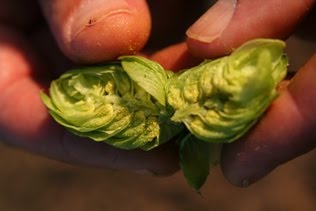
OSU tests IH pellets vs Cones for aroma intensity and oil extraction rates
OK. OK. You want more aroma. Do you dry hop with whole cone hops, or pellets? And how long? You’ve got limited capacity. Do you dry hop for a week, or something less than that?
Questions. For answers, where do you turn? A textbook? A magazine? Your buddy? The BA message forum? Google? Or do you just wing it?
We tried all of the above, but decided the questions were serious enough to warrant serious study utilizing the scientific method and the best available technology.
In short, we called Peter Wolfe and Dr. Tom Shellhammer at Oregon State University. They spent a year researching the questions. It’s pretty interesting, even for a liberal arts guy like me. In fact, it’s fairly startling.
We won’t post the study here, as it has not yet been published. But, for details, give us a call, and we’ll give you a closer look at the data. For now, here’s a summary.
* A 10 member sensory panel evaluated the intensity of dry hop aroma from Cascade pellets and whole cones and concluded that the pellets provided more intense aroma.
* Beer samples dry hopped for one day had significantly more aroma than beer dry hopped for 7 days.
* Irrespective of form (pellet or whole cone), the concentrations of hydrocarbon terpenes (eg, myrcene, humulene and limonene) peaked between 3 and 6 hours in dry hopped beer and then declined, while the concentrations of terpene alcohols (e.g, linalool and geraniol) continued to increase throughout the 24 hour dry hop extraction.
A few caveats.
First, not all pellets are the same. The pellets used for this study were supplied by us, Indie Hops, and we’ve previously shown that our pellets are different in terms of the average particle size, the diameter and the “bakedness” (our grist is extruded at between 106F and 115F).
We’re gratified to learn that our pellets produced about twice the intensity of aroma than whole cones. That’s huge! The conclusion reinforces what common sense told us: nature designed the hop flower to keep the oils “in”, not let them out, while IH pellets were designed by guys who wanted to get the oil “out.” We deliberately designed our mill to chop up the cone in bigger, coarser particles so that we could open up without pulverizing the oil-exuding lupulin glands.
Second, the rapid extraction rates were likely influenced by the temperature of the solution (23.3C, which may not be representative of real world conditions), and the hops were continually stirred. Although there’s been ongoing anecdotes and discussion about methods for agitating or recirculating/re-entraining hop grist in the tanks, we don’t have a reasonably available tried and true technology for re-suspending hops during dry hopping.
The research suggests, however, that the machinery needed wouldn't be too terribly difficult, and it only need to engage for a few days.
Third, the sensory panel consisted of 10 trained beer geeks who measured the aroma intensity on a scale of 0-15 based on the smell, not taste. To quantify the aroma compounds extracted (e.g., linalool, myrcene, etc), as well as the extraction rates, OSU used all the usual hi-tech stuff.
The take home: if you don’t have a torpedo, prefer (IH) pellets over cones, don’t have limited tank capacity and like big oily aromas, you’re not measurably losing anything, other than lore points, by not using whole cones.
And if you really love big oil, keep noodling and tinkering with new ways to keep those pellets circulating. And if you really love big oil but aren’t big, if you can keep those pellet particles suspended, you might also be able to save money by shaving 3-4 days from the standard dry hop schedule.
In the meantime, we’ll keep asking the questions.
RGW
2/29/12
The name of the unpublished manuscript is: “Dry Hop Aroma Extraction and Sensory Evaluation Report on Phase II dry hopping experiments,” by Peter Wolfe and Thomas H. Shellhamer, Ph.D, Dept. of Food Science and Technology, OSU, Corvallis, Or. (1/2012).
Note: Check out these Guth Portable Agitators used for mixing, stirring and homogenization of liquids such as wine. Could the same technology be modified for use in agitating hops during dry hopping?
Saturday, April 2, 2011
Indie Hops Organics Update: 2012 Will Be a Big Year for the Big O
Indie Hops began growing organic hops last year. At Goschie Farms, we currently have 12 acres established on acreage that will be certified organic for the 2012 harvest. Of those acres, ten (10) are Cascades and two (2) are Centennial. Last year, an abnormally long and wet Spring triggered a downy mildew breakout. Fortunately, the DM spores did not strike our organic fields. Whew!
We will be planting additional acreage in 2011 on Goschie Farms as follows:
3.2 acres Centennial
3 acres Newport (15% AA, 50% Magnum parentage, CoH 38, 2.0 oil, good storage, Resistant to DM)
3 acres Perle (9% AA, 28 coH, 1.1 oil, very good storage, resistant to DM)
1 acre Fuggle (6% AA, 27 CoH, .6 oil, DM Tolerant)
All of the above varieties from our 22.2 total organic acreage will be available in 2012. Our pellet mill will also be certified organic for converting the 2012 harvest into pellets. We are pleased to note that organic hops won’t need to be trucked from Oregon farms to Yakima to be pelleted and then trucked back to Oregon brewers. Our Big O hops will be both green and greenhouse friendly.
Low Trellis, High Plant Strength
Gayle Goschie, our hop whisperer, is excited about her decision to string the organic hops on a low trellis. Organic hops face all sorts of disease and pest pressures. The best bulwark against nasty invaders is a healthy plant with a strong root system (and of course a monsoon-free spring!)
By using low trellis, we will not cut the bines at the base during harvest. The picker will strip the cones and leaves from the sidearms, but let the remaining “stripped hop skeleton” live on for another two months. During that time, the nutrients and carbohydrates in the bines will continue to nourish the root system, making for a hardier plant the following season. When the bines dry out, they will be cleared.
Hope Springs Eternal but Cross Fingers
2010 was a wet year – Biblically wet. Add moisture and warmth to soil and you have a fertile soup for mildew. Last year, we waited until mid-May for the ground to dry up before planting our Cascades and Centennials. The strategy paid off, as so far our fields look great, with the caveat that our vigilance must step up as the rains begin to recede in the Willamette Valley as the sun breaks out and the soil warms up.
To be safe, we will be planting our additional ten organic acres (Centennial, Perle, Newport and Fuggle) also in mid May. At present, our wonder weeds are getting stronger in a cool greenhouse. Later on we’ll transfer them a shade house before planting in the ground.We’re optimistic, but crossing our fingers, toes and legs that the Spring will be dry enough so that Gayle “the Hoptomist” can walk the fields and spot treat any pest or mildew sightings. Last Spring was so wet Gayle couldn't get her tractors out to aerate the soil as often as she wanted.
One thing’s for sure, we’ll have plenty of pretty photos of our organic yards this summer. Between the hop rows Gayle will be planting vetch, an excellent nitrogen-fixing legume that bears lovely lavender flowers.
The Price is Right, We Think
The first question brewers are asking is whether the variety they want will be available. The second question is how much more will they cost than conventional hops?
We chose the varieties that we think have good disease resistance (Centennial will be the biggest challenge) and strong demand by brewers. We confess that we struggled with how to price our future organic hops. Clearly, the establishment and production costs have been greater than conventional crops. It takes three years for the acreage to transition from conventional to organic. Because of the pest and disease threats, the yields will likely be significantly lower. And processing will be more labor extensive, as well need to purge our clean, green pellet mill of any conventional hop residue.
So what do we do? How about, hmmm, the honest and right thing? We talked to both our grower and to potential brewer customers. In the end, we decided on an adjustable formula that ties the price to the yield. The higher the yield, the lower the price. On the flipside, after setting a fixed maximum price, the lower the yield, the higher the price.
We’re All in this Together
Our philosophy in setting the price is simple: we’re all in this together. This is a time of transition. Organics are no longer a fad, as consumers have begun to embrace the environmental and health benefits of synthetics-free foods. But to get to that point where the price gap between organic and non-organic hops narrows, the farmers will need to get it right. That takes time, trial and error, persistence and luck.
Here’s what we came up with: a maximum “worst case scenario” price per pound has been set at $18.00. That way a brewer knows that even in an extremely low yield situation there is a ceiling to what they need to pay for organic hops. The table below shows the price decreases as yields go up. Hey.... those prices look better than conventional hop prices during recent years!
Our agreement with the farm is that revenue from organic hop sales will first go toward covering the farms costs of organically cultivating the 20+ acres of hops. Once the farms costs are covered, the sales go toward covering the smaller IH direct costs of processing and handling. With direct costs covered for both parties, any additional sales revenue will be split 50/50 since we have shared the costs of establishing the organic acreage over the four years prior to the first certified organic harvest.
Yield per Acre (lbs.) Wholesale Price/lb.
Less than 750 lbs. $18.00
750-849 lbs. $17.50
850-999 lbs. $17.00
1000-1199 lbs. $16.00
1200-1399 lbs. $15.00
1400-1599 lbs. $14.00
1600 and above $13.00
Brewers interested in planning ahead for some of their organic hops needs are encouraged to come visit this year to see the progress of the crop themselves. We also encourage you to contract ahead for greater security of supply.
We of course remain encouraged by Gayle’s optimism. We’re also buoyed by the slow but steady progress by “chemical companies” to ramp up production on organic compounds to control the undesirable pests, weeds and mildews.
Let's raise a pint to insecticidal soaps, fish oils, garlic extracts, biopesticides and plant and soil boosters! May the salubrious lady bugs and the pernicious aphids find a happy balance. As for mildew, can we please have more sun and less rain this Spring? And, if not, a note to the nasty mildew spores: may Gayle find you and give you a farewell squirt of hot copper.
RGW
4/2/2011
For an excellent article on the challenges faced by organic hop growers, please read the April 2011 issue of The New Brewer, “ New Rules for Organic Hops: Time is of essence for brewers, growers.” Click here.
Monday, March 28, 2011
Thanks for Stopping By!
![]() |
| Matt Sage dealing the green gold |
We had the pleasure of talking with brewers from Anchorage to Atlanta and from Portland, Maine to San Diego. Wherever they were from, a few common themes emerged.
Brewers understood the importance of keeping publicly owned varieties alive and well. Many a woe was expressed about the undersupply of privatized hop varieties to which the bereft brewer had become "addicted."
Brewers also understood that they could exert control over their future hop supply with reasonable and fair contracts. The days of living off the scraps that dropped from the tables of the big brewers are long gone. As one brewer put it, "Contracts have gotten a bad rap because of what happened in 2008 but they're the best bulwark against radical swings in supply and price."
We heard about one merchant offering a brewer Cascades for under $3 per pound. Three dollars a pound?!? For artisan aroma hops? Three dollars a pound is well below the costs of production and processing. It's a price so outrageously below market one is forced to ask whether the merchant is dumping hops with the goal of driving out competition.
Just a few years ago merchants were demanding $25 for Cascades. As Matt Sage wisely warned: "If you want to avoid paying $25 for hops, don't pay $3." Makes sense. Negotiate a price that is sustainable for the hop farmer, the hop processor and the brewer. Most brewers get it that quality artisan hops are going to cost more than factory-farm high-alpha varieties.
![]() |
| Roger and the HOP Queen |
Had a wonderful time talking about all the good stuff Indie Hops is doing with hop oil maturity studies, oil extraction experiments, organic hop production, and our aroma hop breeding program at OSU. More importantly, I learned more about what keeps brewers up at night. I like to live by the old adage -- ain't no problem we can't solve.
Thanks again for dropping by the Indie Hops booth. It's great to be part of a thriving business that's equal parts inspiration, perspiration, science and spiritual awakening. The best statistic I heard all week is that while Craft is around 5% of the US beer production we produce 50% of the jobs! Very cool.
RGW
3/28/11
Monday, March 21, 2011
Hop Harvest Time: When and How Do You Know? OSU’s Tom Shellhammer Has A Clue

How will you know when that optimum has been reached?
Do different aroma oils reach their maximum concentration at different times as the cone ripens?
These are some of the questions that drive Indie Hops to fund hop ‘maturity’ studies at Oregon State University. We are pleased to announce that the results of our first effort to wrestle with this topic will be presented at this year’s Craft Brewers’ Conference in San Francisco by OSU Professor Dr. Tom Shellhammer on Saturday, March 26th.
In late summer and early fall of 2010, Cascade and Willamette hops were collected on three successive weeks at three Oregon locations and analyzed for aromatic compounds by Gas Chromatography and Mass Spectrometry. Thirty-one different GC ‘peaks’ were identified and compared.
In a fortunate coincidence, single hop beers using some of the very same hops were brewed by Deschutes Brewing and later judged by a sensory panel at OSU. This allowed us to relate some of the lab analysis to actual flavor perception in beer, something that will be pursued more fully in subsequent projects.
The complexity of hop aroma is so great that it’s not surprising to find that each attempt to answer one question brings several more to the surface. And although this first study is too limited to produce any grand conclusions, some commonly heard notions about hops now seem to be less certain. If you’re going to CBC, consider attending Dr. Shellhammer’s presentation to judge for yourself.
Perhaps some day we’ll learn that a 5-day difference at harvest can mean the difference between a decent well-hopped craft beer and a remarkable one.
See you at the CBC.
3/21/11
Tuesday, February 15, 2011
Going Big on my 50th Birthday With Kevin Buckley’s Imperi-Ale 5.0

More’s not always better. Sure, it’s quite a thrill to land that gnarly jump or ride that killer wave, but there’s a point where raising the bar will eventually kill you. Sort of like with imperial IPAs – a bigger IBU doesn't usually translate as a better tasting beer.
With that challenge in mind, I asked my friend Kevin Buckley to work outside his comfort zone and brew a specialty “big beer” for my 50th birthday. Kevin doesn’t normally toil away making gigantic “hop bombs,” but he generously agreed to give it a go.
The marching orders: use all Oregon grown hops supplied by Indie Hops; use about 5 pounds per barrel (to match my 50th), and unleash it on the night of my roast, cold (two months hence). The name: Imperi-Ale 5.0.
Kevin brewed with our Nuggets (13.9% AA, high essential oils), Centennial (11.5% AA, also high in essential oils), and Cascades (8.5% AA) per the following schedule:
First Wort-Nugget 2#
60 min-Centennial 2#
60 min-Nugget 3#
15 min-Centennial 2#
15 min-Nugget 2#
Whirlpool- Centennial 1#
Whirlpool-Cascade 2#
Primary ferm-Cascade 5#
Dry Hop-Cascade 15#
Dry Hop-Centennial 6#
Dry Hop-Nugget 4#
Dry hopping with Nugget? We admired the pluck, but were a bit concerned. Although it’s not uncommon to dry hop with super alphas that also have high essential oil (e.g., Columbus, Magnum, Summit, Simoce), most of said oil consists of myrcene and we were worried about off flavors (cat piss, grassy or machine –yuck!). How would all those essential oils, mainly myrcene in the Centennials and Nuggets, react with the alcohol, Co2, yeast, sugars, and oxygen?
Surprise Surprise! The result was a highly drinkable, well-balanced, pleasantly fruity beer without the sharp bitterness you might expect from a hop-forward ale clocking in at 98 IBU. The 8.7% ABV proved dangerously unnoticeable, as my fired up and emboldened friends lapped it up and proceeded to pound me unmercifully. Hey, like I told my roasters: A true friend will stab you in the front! (quoting Oscar Wilde). It went quickly.A few of the comments on the Imperi-Ale 5.0 from the not exactly naïve quaffers in the room: a mildly sweet front end with a touch of melon flavor… A clean transition to a gentle bitterness… Moves towards a citrus/spicy note nurtured by a warming bready-toasty character of malt…. Finishes with a crisp melon punch and caramel sweetness, capped by a touch of lingering bitterness…
As Kevin modestly explained: “This brew, while loaded with hops, was designed to be big yet enjoyable for all levels of drinkers. For the extreme hop heads, there are moments when the hop bitterness shines through. For those partial to red/English pales, there’s plenty of body and malt complexity.”
Thanks Kevin. You went Big and we enjoyed the ride. And thanks for experimenting with our Nuggets for dry hopping. It’s a credit to your brewing talents that you were able to land this hugely hopped beer with grace and style (in stark contrast to Mr. Solberg, who after a few hours of steady infusion fell like a Mighty Doug Fir).
Imperi-Ale 5.0 was launched last week and Kevin’s customers are loving it. There’s still a few kegs left, but you should probably beat a hasty path down to Backstreet Brewery in Vista if you want to taste this break out, all Oregon grown hops beer. Hey, to those of you who might’ve stereotyped IH as an aroma only outfit, we can go big with the alpha, too!
Roger Worthington
2/15/2011
Tuesday, February 8, 2011
Variety, Uniqueness, Consistency
Perhaps more than any other arrow in the quiver of ingredients, hops cast a spell on brewers and imbibers of American craft beer, tickling the potential for variety and individualism. Their symphony of oils reaches each of us with a unique tone, the crescendo leading some to ecstasy and others to seek refuge. We continue to be amazed at how wildly different educated palates can interpret the same hop.
Last summer a focus group panel was held that illustrates these varied perceptions toward hops. A group of accomplished craft brewers from Oregon tasted a series of single-hopped beers, not knowing what the hop was in the various samples. Descriptors they used to describe the prevailing hop character, and the number of panelists who used that descriptor, are below:

Clearly, one brewer’s nectar can be another’s poison! [One guy’s fruity apple can be another’s cat pee?]
As we’ve striven to learn from brewers how they’d like to see the hop world evolve, this theme of variety, creativity and uniqueness stands out.
Our resident brewer and Brewery Ambassador Matt Sage has recently travelled the craft brewery scenes in Washington State, Oregon, Southern California and Colorado, seeking insights into what brewers are looking for in hops. His findings are as varied as his travels! Click here for a taste of Matt’s curious adventures in the world of hop flavor.
Alongside variety and uniqueness, brewers also care about consistency. After all, when we find something we really like, we want it to be consistent. What can Indie Hops do to help the hop world evolve in a way that craft brewers would like to see? Well...might as well start with variety, uniqueness and consistency!
Click here for a review of a few of the breeding projects underway at Oregon State University that we are spearheading in our quest to probe the mysteries and amplify the wonders of the noble flower.
Cheers!
JS
jim@indiehops.com
2/8/11
Monday, January 24, 2011
The Low Down on Simcoe®
Having trouble getting Simcoe®? You’re not alone. A ton of brewers have asked us for Simcoe®, which we don’t have, as it’s a proprietary hop owned by Select Botanicals Group, LLC, who restricts who can grow it. Our growers have not been licensed to plant Simcoe®.A brewer in Southern California recently told me he just bought the last 3,000 pounds. I didn’t ask what he paid, but in view of the high demand and short supply, I’m sure the “spot” price was not pretty.
The scarcity of Simcoe® and the near-desperate demand prompted me to poke around. First, let’s look at the sheets. Yakima Chief Ranches,Inc. applied for the original patent in 199. They identified Simcoe® as a dual purpose bittering/aroma hop, with a hefty yield of 2300-2500 pounds per acre. The current owner of the trademark Simcoe(r) is Select Botanicals Group, LLC, of Washington.
A review of the USAHops website shows that the Washington farmers planted 237 acres of Simcoe® in 2010, up 29% from 2009. (By comparison, WA farmers planted 443 acres of Chinook, up 15%).
However, the average yield was 1,698 lbs/acre. This is a 20% drop from the year before and about a 30% decline from it’s purported average yield ( 2,300—2,500 lbs/acre). (By comparison, Chinook’s average yield was up around 8% at 1,963 lbs/acre).
I understand that Simcoe's owner has licensed three (3) farms in Washington to grow their prized invention. I'm not sure how many merchants are allowed to sell it.
It’s clear that the supply was down. A baby harvest? Pest or mildew issues? Not sure.
Why the popular demand? Let’s look at Simcoe’s chemistry:
Alpha acids: 12-14% (Chinook 13-15, Centenn. 10-13)
Beta acids: 4-5%
Cohumulone: 15-20% (remarkably low!)
Total Oil: 2—2.5 ml/100 g (huge, on par with Magnum and Centennial)
Myrcene: 60-65% (Chinook’s is 52)
Farnesene: 0% (Chinook and Centenn. “trace”)
H/C ratio: 2.1 (same as Chinook)
Storability: good
Parentage: Undisclosed (the inventor’s not telling)
Brewers have described the aroma as complex, hovering between citrusy/grapefruity and piney. I’ve read references to Simcoe® as “Cascades on steroids.” Interestingly, in Yakima Chief’s patent application, the only hops referenced were Cascade and Galena, in the context of shattering potential and shoot emergence, respectively.
So let’s say you want Simcoe® but can’t get it or don’t want to pay high spot market prices. Are there “alternatives?” Choosing an “alternative” is at best an inexact science. Do we find a cultivar with similar hop chemistry? We can’t compare parentage, as Yakima Chief’s keeping the blood lines secret. We could study key molecular markers on the Simcoe® mystery hop and on likely parental genotypes, but this would take both big time and big money.
For now, if your recipe calls for Simcoe® but you can’t get it, you might experiment with blending hops. We haven’t done the science, nor have we played with pilot brews ourselves, but our hunch is a blend of Chinook and Horizon might do the trick (Horizon for bittering only).
In our view, the spot market spike and scarcity of Simcoe® points up the need for diversification. Brewers should have access to suitable hop alternatives. Growers should have access to rhizomes without paying restrictive licensing fees. Scientists should have access to the parentage, both to develop alternatives as well as to validate disease resistance assessments.
Of course, the shortage also underscores the need by brewers to contract long term with merchants or growers for must-have varieties. In 2011, we will be harvesting our first crop of both Chinook and Horizon. We’re naturally very excited, as over the last few decades both workhorse hops have been the exclusive province of Washington growers.
Roger Worthington
1/24/11
PS. For more information on Simcoe®, click on:
http://www.yakimachief.com/hopvarieties/simcoeyc014.html
To compare Simcoe’s hop chemistry with other cultivars, click on:
http://www.indiehops.com/haunoldpub-privchart.asp and
http://www.indiehops.com/aroma_variety_survey_chart.asp
To read Simcoe®’s patent application, click here
For more information of Select Botanicals Group, LLC, see http://wa.14thstory.com/select-botanicals-group-llc.html
Click here for the trademark ownership.
Friday, December 3, 2010
We are often asked how the “Hop Substitution Charts” available on the web came about. There is some variation among them, but many appear to be carbon copies of each other.
What are they based on? Hop chemistry? Parentage? Sensory Panels? Educated guesswork? Test brews? Marketing sleight of hand? I asked my friends at OSU and the consensus was anywhere between “pseudo-science” to all of the above.
If anyone has any insights on the basis (or reliability) of the hop substitution charts (e.g., see http://www.byo.com/resources/hops) please let me know.
We aren’t so bold as to assert that one hop can be “substituted” for another – at least not without accurate genetic and sensory information. We prefer to say that one might present a suitable “alternative” for another.
When the hop “shortage” struck in 2008, many brewers scrambled to find substitutes for aroma hops. Many brewers tapped higher alpha varieties and to this day have stuck with them. One macro-consequence of this recipe change has been a decrease in the production and usage of aroma hops compared to pre–shortage years.
The recent New Brewer reported substantial decreases in the US acreage of workhorses such as Cascade and Willamette, while acreage in the “dual purpose” powerhouse Centennial has actually increased since 2008.
Based on anecdotal encounters with brewers, I’ve noted a trend towards simplification of the aroma hops used. It appears that while usage of public varieties, such as Sterling, Cascade and Mt. Hood has fallen, proprietary cultivars, such as Amarillo, Palisade and dual purpose Simcoe has gone up.
Of course, when a hop is proprietary, the owner can limit which farmers can grow it. The owner stands to obtain a licensing fee or royalty from the sale of the hop from the grower to the owner/merchant.
Random Sampling of Web-based Hop Charts: Brew 365 |
Since many of the hop merchants in Yakima also own patents on hop cultivars (e.g., Simcoe, Palisade, Citra, Amarillo, Warrior), it’s no secret that between public and their own varieties they’d rather push their own. That’s simply an illustration of the guiding hand of self-interest in a capitalist, laissez-faire economy.
But when each Yakima hop merchant pursues their own self-interest, is it true that Adam Smith’s “invisible hand” magically makes sure that hop varieties are fairly and propitiously allocated in a way that insures the march of the craft revolution?
Is the trend towards less diversity of the hop supply good for crafties? Is the consolidation of hop acreage in Yakima good for crafties? Should crafties rely on foreign imports when suitable varieties can be grown less expensively and more reliably in the US? Do crafties benefit when each year we see fewer heritage hop farmers willing to give it another go? Is the risk of over dependence on a narrow menu of varieties acceptable?
These are big questions. I’m sure the patent owners can make a strong argument that their hop inventions are unique and superior. There’s absolutely nothing wrong with owning patents. It takes years of R & D to bring home a winning cultivar – such as Citra. The question that intrigues us is not whether a proprietary hop is unique, but how unique is it?
That’s where the “substitution” charts come in. Within the framework of the aroma hops breeding program we sponsor at OSU, we will be looking at the design of a “sub” chart that is based on science and sensory analysis.
In the meantime, when brewers ask us for an “alternative” to Simcoe, we suggest Chinook, based mainly on the grapefruity aroma and the similar alpha acid profile (Centennial’s another choice). We’re not absolutely sure on parentage of Simcoe, since it’s proprietary.
It may be best to suggest blends of hop varieties to attain a particular character. As an example, it might be useful to say, “instead of Simcoe, use 50% of Hop A, 25% of Hop B, and 25% of Hop C.” Of course, as OSU continues to develop crosses in the pursuit of unique aroma hops, perhaps the day will come soon when the choice will be simple.
As we explore these questions, we’re always learning more from you about what works. Have you on a lark or hunch swapped out one variety (or blend of varieties) to imitate or, better yet, emulate a go-to hop? How did it go? We’d love to hear about your fortuitous trials and even your not so happy errors.
Roger Worthington
12/3/10
Wednesday, November 3, 2010
Portland, OR. We’ve been asking for brewer feedback and we got some.MacTarnahan’s, which has been brewing award-winning craft brews in Portland since 1986, heard about our new hop pellets and decided to test them out against their current inventory.
Everybody knows that MacTarnahan’s flagship beer is their Amber Ale, which is truly an Oregon original. This bold, copperish “English style” pale ale showcases Cascade hops and Cascade only. They’re used for bittering, aroma and they dry hop with it as well. Talk about your all-purpose utility hop.
Now many brewers who are blessed with a leading money winner object to change. They got a winner and they stick with it. Mostly, this is a reasonable strategy, except for two things:
First, natural ingredients, like hops, over time, can lose their edge (or “brightness”). Heck, hop flavor can swing from the same variety during the same year from the same farmer but grown on different farms or harvested at different times.
Second, whether you’re on top or trying to get there, complacency is the enemy of progress. Yes, yes, there are those who would fall back on the old nostrum – if it ain’t broke, don’t fix it. Sounds good, but leaving well enough alone in the ever-changing craft beer world sometimes just isn’t good enough.So imagine our surprise, and elation, when veteran brewers Tom Bleigh and Vasili Gletsos (the new Head Brewer for North American Breweries(NW Divison/Portland location), which owns a bunch of crafties, like Magic Hat, Pyramid and MacTarnahan’s), informed us that they wanted to pit our Cascade pellets against their current vendors’ in test batches of their most popular brew, Mac’s Amber Ale.
According to Tom, Plant Manager of what most people know as the Portland Brewing Company, tinkering with a winning recipe in the pursuit of perfection shouldn’t come as any surprise. Although his brewery is under new ownership, the commitment to excellence, he says, has actually gone up.
“We’re constantly looking for ways to improve our beers and our brewing process so that it’s focused on being efficient, environmentally friendly, and insuring quality in raw ingredients and finished products,” said Tom, who’s been brewing since 2001. “I firmly believe that if we focus on what matters most: quality and safety, success will follow.”
Tom acknowledges that getting hops right is a full-time job. It’s never one thing, he says. Instead, it’s a combination of factors that lead to desirable hops, from the farm, to the harvest date, to the pelletizing, to the packaging, to brewing, to the bottling and finally to the delivery and pour.

“Naturally, we’re very pleased with our hops,” assured Tom, whose prestigious brews speak for themselves. “But we were interested in what you guys, Indie Hops, were saying about your new pellet design and the Willamette Valley terroir. We wanted to see if there were any differences from Washington grown Cascade pellets.”
The experiment went down like this. Macs brewed up three batches: two using Cascade pellets from two existing vendors, and one using Indie Hops’ 2009 Cascade Pellets. They chose their Amber Ale as the medium.
And, to evaluate how or whether the hops would perform under actual “battle field” conditions, they subjected the three batches to a “force test.” They exposed to the beers to the type of peak heat temperatures that would basically simulate a six pack getting locked inside the trunk of a car in August for a few days (not that any customer would do such a thing to Mac’s Amber Ale, or any good ale for that matter). The idea was to speed up the oxidation process that naturally occurs under predictable conditions.
In total, three test brews split between “fresh” and “forced” conditions. After evaluating the brews internally, Tom and Vasili invited Indie Hops over to wet our collective whistles and – and this is the sweaty palm part -- put our money where our mouth is. They didn’t tell us what was what, of course. They wanted our no BS feedback.
Oh Lord, please pick the right one!! Jim and Matt each blindly sampled and rated all three. Jim recalls the pucker factor. “First, I’m not a pro taster. And second, one of the samples didn’t taste so hot, but I couldn’t be harsh – what if it was ours? I’m confident, but I’m not dumb!”How did it turn out? Did Jim and Matt agree on the winner? And who was the winning hop merchant? Indie Hops or our friends up North?
Well, let’s just say that it’s better to be good than lucky. We’re thankful to Tom and Vasili and all the guys and gals at MacTarnahan for putting our theories to the test. Feedback is great, but validation is awesome!
With a proven winner like Mac’s Amber Ale, is it possible to increase expectations? We think so. In the war against mediocre beers, there’s no room for complacency.
Roger Worthington
11/2/10
Thursday, August 26, 2010
Freedom Hops: The Case for Public-Private Breeding Partnerships
Those who know me understand that I tend to fixate. I get the sandy grain of an idea, apply loads of constant pressure (with maximum compression around 3 in the morning.) and either a blood vessel bursts or out pops a pearl.Here’s my latest pearl in process: the need for public-private hop breeding partnerships.
Here’s what started the itch. I was perusing the Strategic Plan of the Hop Research Council (1998, updated in 2007). By way of background, the HRC consists of a few larger brewers and all the usual merchants in Yakima. These are the insiders who have a tremendous influence on the direction of how public research dollars are spent. They also assess themselves certain fees and make additional money from HRC available through research grants.
Now, everybody knows that I think the world of Dr. Al Haunold, an extraordinary public servant I’ve heralded on this blog as “the People’s Hopmeister.” After escaping the Nazi War Machine and emigrating to the US, eventually my Austria-born mentor came to work at the USDA in Corvallis where from 1965 to 1996 he took the lead in releasing to the public over 20 new hop varieties.
Twenty! For Free! Al didn’t patent those inventions. He never saw a dime from any royalties because there were no royalties – not then, not now. Neither did Uncle Sam, nor anyone else on Al’s team of public breeders. Anybody can get access to rhizomes for hall-of-fame US varieties like Cascades, Willamette, Nugget, Liberty, and others – all the hopwork of our Nation’s No. 1 Hopmeister. Anyone can get ‘em, and anybody can grow ‘em.
Al retired in the late 1990s but his final collaborations were not released until the early 2000s, to wit: Newport and Mt. Rainier (both crosses made by Al in 1994), Horizon (cross made by Al in 1970), and the low-alpha Teamaker. By the way, Teamaker’s roots go all the way back to 1970. The brewers were not keen on it because it contained virtually no alpha acids. But his technicians loved it for brewing hop tea.
Since then – the early 2000s -- not a single variety has been released. What happened? Did the USDA lose its edge? Did they surrender? Or did they just in fine George W. Bush fashion hand over the keys to the candy store to private industry?
To answer that, let’s go back to that HRC “strategy” statement that has so jarred me – a statement which in truth prompted me to get into the game and to sponsor an aroma hop breeding program at Oregon State University.
Here it is, verbatim, from the HRC strategic plan (click here to read the entire text).
"While varietal development is a critical requirement for the continued success of USA hop growers, there is some concern that public breeding programs should not be involved in the development and release of varieties."
Huh? What’s so egregious about public servants serving the public? Who voiced this "concern"? Private breeders who saw an opportunity to fatten up with their snoots in the public’s trough? I asked Al whether there was any fuss about him taking his work too seriously, that is, depriving private breeders of their chance to make a buck on the public’s dime.
Al shrugged off the strange insinuation. "No, I wasn’t aware of any concerns. We didn’t start seeing any private breeders in the US until the mid 1980s when the laws for patenting agricultural products became more lenient. Before then, I actively worked with brewers, farmers and merchants, and we all got alone fine." With stellar results.
The HRC statement continues:
"Several private breeding programs actively work towards developing and releasing public and proprietary varieties grown with the support of a marketing system that helps growers sell their product on the world market." (Italics added).
Private breeders release “public” varieties? Well, that’s a new one. Al just had to laugh. “That’s an oxymoron. A private company can’t make a public release. I don’t know what they’re talking about.” Aside from this nonsense, the meaning is clear: the merchant-big grower-breeder industrial complex has set its sights on controlling the world market. That hop hegemony begins with patenting varieties and granting licenses to selected growers. An excellent strategy for controlling the price and supply of US hops.
It gets better:“In almost all other crops, public breeding programs no longer serve as the major developer of varieties but do serve as developers of germplasm containing a specific trait… Germplasm developed by public programs is then utilized by private breeders for use in the development of superior varieties – the better the germplasm, the better the varieties that are ultimately made.”
Whoa doggies! First, the phony argument that “everybody’s doing it.” Second, no attempt to proffer evidence that the public is hurt by an aggressive, efficient and amazingly productive public breeding program. Third, the cavalier way in which the privatizers skip over any ethical issues and swinishly assert that the fruits of the public’s labors is their god-given birthright.
“I disagree,” Al offered modestly. “If the public program develops the tools that help us breed superior varieties, then the public should continue to be involved in bringing new varieties to market. In fact it’s more efficient, as the tool makers generally know best how to use those tools in the field.”
What does this mean for Al’s legacy of public service? “Well,” Al pondered, “it’s appears to have been ruined by the pursuit of profit. The private breeders smelled the money. They want the public to subsidize the creation of the tools – the germplasm, which can select for higher yields, disease resistance, etc – but not share anything in return. They want to restrict access by farmers. That goes against everything I worked for.”
The privatization model kicked in about the time Al retired (nice send off, boys!). How many aroma varieties have sprouted since then? Amarillo? Well, that’s an aroma, but it wasn’t the result of a private breeding program—the Gamaches found it on their farms and trademarked it, which means only they or their chosen few can grow it. Ahtanum? It’s relatively recent, but we don’t know much about its parentage. Citra is a recent privately developed hop, and by all accounts it’s a home run. But we don’t know much about where the germplasm came from. Was publicly owned germplasm exploited? If so, did the patent owner agree to share any royalties with the public?
And that’s the point. There is absolutely nothing wrong with private breeding. It should be encouraged. It’s risky. It’s expensive. It’s time consuming (8 – 12 years on average). As long as there is robust access to public varieties, the profit margin on any new variety is a matter of speculation. And any breeding mission will necessarily involve brewer feedback, just as Citra did with Sierra Nevada and Deschutes, to name a few.
The wicket gets sticky when private breeders utilize public germplasm, develop a “new” variety and then attempt to patent it for their own personal gain without sharing the fruits. Since patent applicants generally insist on keeping secret their formulas, recipes and designs, they jealously guard the pedigree of their plants like the proverbial rich ugly old maid and her silver spoons.
How are competitors going to know what’s off limits? And how does permanently restricting access to varieties by farmers, growers and other merchants help grow the craft beer industry anyway? And think of the potential for corporate espionage: it’s not inconceivable that breeders will raid USDA germplasm depositories before the cell-lines are publically released. (See the History of CTZ, here.)
That’s one big reason why Indie Hops funded the aroma hops breeding program at OSU. Public hop breeding, especially of aroma varieties, had essentially died not too long after Al retired. Our goal has been to empower OSU to invent, invent, invent. With inventing comes ownership. With ownership comes the right to impose reasonable conditions. With conditions comes the potential for royalties. With royalties comes a predictable revenue stream, a big chunk of which can be re-invested back into a public-private program.The death of public hop breeding programs, we believe, is not only a shame, it’s a punch in the stomach to the work and legacy of The People’s Hopmeister, Al Haunold. Indie Hops stepped in after InBev/AB pulled out to fund a first-ever aroma hops breeding program in large part to continue Al’s pursuit of hops.
Does this mean we believe we are entitled to complete ownership of any new hop “invention?” Absolutely not. We believe in sharing. We look forward to executing on a public-private model that exacts sweat, skill, equity and labor from each stakeholder and commensurately rewards them while also serving the hop growing and hop-loving public.
Roger Worthington
8/26/10
Thursday, August 19, 2010
“The only educated man is a self-educated man.” Mark Twain
Kevin’s a likeable, knowledgeable, self-taught sort of hipster (yes, his head’s adorned with the usual pins, spikes and rings). But he’s not exactly an easy going surfer dude. He leans more towards the mindset of the perfectionist, with a readiness to make do with the ingredients and equipment in front of him.
At the tender age of 28, Kevin’s the master brewer of Back Street Brewery in Vista, California. His training was, like so many craft prodigies, far from typical. He didn’t learn the brewing arts at famed Siebel Academy, but he did toil a few years at a brewery in Iowa under two Siebel grads. “I just read their books and manuals on my own,” he said with the satisfied grin of an artisan jack-of-all-trades.
Kevin’s been brewing for Back Street since April. When he arrived in April, Back Street had about four in-house brewed beers on tap. Today, Back Street offers between 8 and 10 taps of it’s own hopped creations.
Vista is in North County, near Stone Brewing, Green Flash and Lost Abbey, all progenitors of big bold beers. Not surprisingly, when Kevin took the job after a stint at Alpine Beer Company, Kevin’s first order of business was to bring home an Imperial IPA, the signature bourbonesque brew of San Diego (by the way, Kevin is an avowed fan of bourbon).Kevin, who grew up wanting to be a chef, loves hops the way a pastry chef loves sugar. He uses lots of hops – in fact, ton’s of them. He brews using a vintage, 1990-ish Bohemian 21 BBL kettle and a series of 15 bbl capacity fermentation tanks. For his Rydin’ Dirty Rye IPA, he uses about 3 pounds of hop pellets per barrel. For his Ali Rae Imperial IPA, he uses a whopping 5.5 pounds per barrel! My mouth waters at the thought. Ok, I admit it’s watering partially because both of those weighty concoctions showcase Indie Hops’ Cascade and Centennial pellets, and heavens they’re tasty!
Since his arrival at Backstreet only 6 months ago, Kevin has doubled the output from around 250 barrels per year to a pace that will generate about 550 barrels per year. He does it his way: no assistants, not much mentoring, and very little oversight. He doesn’t have a filter or hop back, so he improvises. He’s a quick study with a brain like a sponge, eyes like a hawk and ears like a cat. He’s confident, but far from cocky. He’s humble, but clearly unafraid to push the envelope.
I caught up with Kevin at Back Street the other day. He’s been buying a fair amount of our hops and I wanted his feedback.
RGW: Tell us about your experience with using Indie Hops pellets for dry hopping.
KB: I heard about your coarse design and wanted to check it out. When I opened the foil, I sensed right away a difference. Your hops were thicker and oilier. They looked greener and fresher. It was always a mystery to me why Type 90 pellets were so fine and tiny – they just tended to sink to the bottom and sit there. Yours didn’t quickly settle, they sort of bloomed, like you’d expect of a flower.
RGW: What about the aroma?
KB: Your Cascades have that quintessential floral, grapefruity aroma. When I brewed with your Cascade whole leaf hops, the brew house filled with that special aroma, the way a kitchen fills with that smell of homemade cookies in the oven.
RGW: How did you add the pellets to your tank? Did you use a bag or drop ‘em right in.
KB: I use a small muslin bag when I pull off casks. But for dry hopping, I just poured them from the top. Your pellets are slightly bigger than average, so I rigged up a White Labs’ Yeast jug, which has a 2 inch diameter pour spout which matches up with the portal on the roof of our tank. Just weighed out what I needed and poured ‘em right in.
RGW: Do you do anything to recirculate or re-entrain the hop mash after it has settled?
KB: I usually ferment for about a week and dry hop for two. Every few days dry hopping I would rouse or blast CO2 for a few seconds through the bottom. I’m mindful that CO2 may impact the aromatics of the hop oils but I haven’t detected any off flavors. On balance, between a pump and the CO2 to rouse, it’s more efficient for me in terms of labor and sanitation to rouse the tanks every 2-3 days, so you get that contact with the hop plant surface area. Sort of like a tea bag: you want to let it steep but then punch it a few times to draw out as much oil and flavor as you can.
RGW: Any drainage issues?
KB: Nope. I just draw out the hop sediment and divert it to the drain into the public sewer. It’s not a problem, although the drain screen wasn’t exactly designed for a thick mash of hop sludge.RGW: So what are you looking for from your hop suppliers?
KB: Two things: an open line of communication and dedication to quality. Look, I know we’re not a huge account. That’s why we need quality hops, so we can attract more customers. When I have a question, or an issue, I’d like for my supplier to listen. For example, at a different brewery, when I opened up the bags, I had to pre-sift the whole hops for sticks, stones, stems, wires and debris. In fact we thought about collecting all the junk in a bucket, weighing it, and asking for a refund!
Another example: with our Amarillos, we were getting a steady stream of seeds. The seeds were clogging up the screen filter in our heat exchanger. We need hops that are as seed-free as possible. They can clog, but the tannins can also deliver funky off-flavors.
In any case, the attitude from our supplier was dismissive. Yeah, I know, we’re not a huge brewer, but I don’t get it. If I brew a sucky beer, I lose business and they lose another customer purchasing their hops.
I’m not a big fan of the Starbucks, ‘standardized mediocrity’ model. Craft brewers need a supplier who will charge a fair price – not $21 a pound for Cascades! And don’t get me started about storage fees. We need a hop supplier who focuses on flavor, aroma and oil. I think it’s great that Indie Hops has come along to help fill this niche.
RGW: Well, thank you sir. What do you think Indie Hops could do better in terms of its pellet design?
KB: Well, every brew system is slightly different. The bigger the tank, the more challenging it is to simply drop pellets through the roof for dry hopping. We don’t have a hop back or filter, so I’m sure those might present challenges if you want to design an even bigger diameter pellet. Overall, I like the idea of preserving as much of the lupulin as you can. It’s sort of like what the doctors tell you about vitamins: it’s better to get your Vitamin C from real fruits and veggies than relying on a pulverized pill.
RGW: What do you like most about brewing?
KB: The feedback. Nothing sweeter than the smile on a satisfied customer. That smile doesn’t come from magic. A lot goes into making a beer special: quality ingredients, perspiration, inspiration and a bit of luck. It’s great to get paid for doing what I enjoy. I love being a part of the craft beer movement, a competitive but incredibly cooperative industry. I suppose like any brewer I want to earn the respect of my fellow brewers and one day, like Vinnie, or Jim Koch, or Sam Calgione or Ken Grossman, maybe Kevin Buckley will have his line of signature beers.
At about that time – around noonish -- an elderly couple ambled in and took a seat on the bar. The wife robustly ordered an IPA, offering: “We were just up in Mammoth at the Bluesapoolooza. We tried your beer up there, loved it and decided to track you down.” This is how the revolution is won, one satisfied customer at a time.
Roger Worthington
8/19/10
Monday, August 9, 2010
HUBBARD, OR. In the heart of Oregon’s hop country, Indie Hops unveiled its clean, green pellet mill to over 100 craft brewers, hop farmers, OSU and WSU ag scientists and even a few of our competitors last Friday. After plying our guests with BBQ and beers, we cranked up the space age mill and it didn’t blow.
It did, however, to the delight of all, convert a bale of Cascade hops into big, fat, oily Type 90 pellets. As one brewer commented, “They kept crowing about their pellet die temp being under 110F and they delivered. We gunned their pellets at 106F.”
Special guest Congressman Peter DeFazio (D-Or), himself an avid home brewer, delivered a rousing speech to the faithful in which he lauded craft brewing as “a bright spot in an otherwise gloomy economy.” Rep. DeFazio made no bones about it: he’s proud to help nurture a growing industry that generates thousands of jobs at a time when the largest brewer in the US is foreign-owned (InBev/Bud).
It’s well known that Oregonians tend to support their own. Almost 40% of the beer brewed in Oregon is consumed within the state – a testament to brand loyalty as well as customer sophistication. And small in-state breweries own about 11% of the market share in Oregon, the highest in the US.
As Jim noted in his opening remarks to the faithful, "Oregon has it all. We’ve got the soil, water and climate. We’ve got some of the best brewers, the best hop farmers, and the smartest hop scientists in the world. And now Oregon has its own hop processor and we pledge to rise to the same standard of excellence that you have set."
Of course, even the best aroma hops terroir has it’s hiccups. This season was a wet one in the Willamette Valley. The rainy Spring finally did surrender to the sunny skies of Summer, but only recently. (By the way, aroma hops thrive in cooler weather). Insect pressure has been light. Mildew was a potential threat but it stayed manageable. Aphids never posed a serious threat and, thanks to cooler temperatures, the spider mites were kept at bay. The cooler summer has allowed our beloved cones to achieve their iconic plumpness.
The scuttlebutt among the Oregon farmers is that, thanks to the surge in sunshine, we should have a decent – but not banner --harvest, although for certain cultivars it might be delayed about a week. The following is a snapshot of the anticipated harvest for select varieties:
US Tettanger -- August 16-18th
Centennials -- August 18-20th
Willamettes -- August 23ish
Sterling -- September 3-6.
Cascade -- September 6-8th.
Mt. Hood -- 1st week September
As the venerable Val Peacock, Ph.D, recently advised in The New Brewer (July/Aug 2010), brewers are advised to visit the farms from which they purchase their hops. We agree – and we’ll add to that sage advice our own admonition that you ought to get to know your pellet millers and walk their shop. At Indie Hops, we’d be happy to arrange for you to visit the Goschie and Coleman hopyards.
Check for yourself the quality of the hops, the cleanliness of the farms and machinery, the timing of the harvest, the status of any mildew or pest problems, and the operation of the drying rooms. After a tour of the hopyards, we’d be pleased to escort you over to our nearby plant and perhaps run a few bales for you. We’ll provide the earplugs, but even though we tend to get carried away with our pellet design and quality, we’ll ask in advance that you not insert them until we flip the switch.
Thanks to everybody for joining us in the celebration of Oregon’s first pellet mill. We’re very pleased to join the craft beer revolution and we appreciate your support and feedback. Special thanks to Bridgeport, Lucky Labrador and Full Sail for bringing the beer.
Roger Worthington
8/9/10
Monday, June 14, 2010
Larry Sidor is a whole hop guy. It’s basically non-negotiable. Having worked for a Yakima hop merchant and an industrial brewer back in the day, Larry has seen first-hand the ravages that processing inflicts upon the noble flower. The Master Brewer for Deschutes who has brought us Abyss, Dissident, Red Chair IPA and Green Lakes Organic Ale (my personal favorite) is a big fan of fresh, wholesome ingredients.
“As a rule, the less we tamper with it, the more I’ll probably like it,” he says.
So you can imagine my trepidation as I walked inside the Deschutes Brewery in Bend with my cooler of hop pellets to meet up with our hop purist. As I told one brewer earlier about my hop ambitions, my goal is to one day create a hop pellet that earns the blessing of Larry Sidor, the High Hop Priestess. I was of course prepared for a polite but firm woodshedding.
What I got instead was a captivating tutorial by a man who not only knows his craft but is eager to learn more. Although Larry is a stickler for whole cones, occasionally, when a beer screams out for pellets (and he's a few bales short), he will listen. Larry had on hand four pelletted varieties from four different suppliers: three from Yakima and one from Germany.
The first noticeable difference was the diameter. Yakima numbers 1 and 2 were 4 mm diameter, Yakima #3 was 6 mm, and the French variety was also 6 mm. Our pellets were 6 mm, and in general they were longer.
The second detectable difference was the Yakima varieties were harder and more baked. A few showed tell-tale signs of “rat-tailing,” a new word I picked up which, as Larry, explained, meant a harder “shell” on the outside of the pellet, indicating excessive heat during pelletization. As previously reported, Indie Hops has been able to lower the temperature at the die of it's spanking new 'patient' pelleting mill without coolants to 104F – 110F, whereas the Yakima standard is 130F.
Third, the Yakima varieties crumbled into a fine powder, the French pellets broke up into a coarser grind, and the IH pellets offered the coarsest grind. I asked the Hop Oracle about the importance of the coarseness of the pellet grist to the craft brewer.
“You have to go back to the beginning. We started pelleting hops back in the mid 1960’s for one reason: whole hops occupied too much valuable space, which translated into higher shipping and refrigeration costs. By increasing the bulk density, we could store and ship more pellets at a lower cost. But the downside was a loss in hop quality.”
“There’s nothing magic about a 4 mm pellet. The smaller the grind, the more cut surface, which means more leaching of vegetative materials into the beer,” Larry rolled on, clearly enjoying his platform. “The English have used ‘plugs,” which are about 25 mm, which they inserted into the bunghole of the cask, but I’ve never seen them produced in the US. A puck-sized pellet with a coarser grind would be … interesting.
We then dropped the hop pellets into a pint half-filled with hot water. The IH brew had the biggest fluid absorption and fiber expansion rates. The pellets on contact sort of blossomed like a dehydrated chili of Brussels sprouts (or, maybe, like a chia pet?).
Next we compared the pellet fiber expansion with the Real Deal, a cup of compressed whole hops (see photo below). During dry hopping, Larry puts the cones into a bag which he secures to the bottom of the tank. As he explained, the ethanol and Co2 in the wort combine to help extract the lovely oils from the lupulin.
Larry posited that a whole cone is better able to preserve the precious lupulin glands by virtue of a sort of “anti-oxidant barrier” contained in the tannins. “When you chop up the hop and rupture the glands, the only shield left is the foil used to bag the pellets,” he said, again in the easy manner of a professor with a boatload of diplomas. “The outer bracts of the whole cone, as well as the in tact membrane of the lupulin gland, provide a natural barrier to oxidation.”
This struck me as an interesting notion, the idea that the cone’s skin of natural anti-oxidants served to insulate the lupulin from degeneration. After class adjourned, I did a bit of digging. First, a bit of hop morphology. Most of the tiny, grandular lupulin glands are located at the base of the bract but others are scattered on the external bracts (or scales). Preserving all of them in tact sounds awfully difficult. The process of picking, drying and then tightly compressing the flowers into bales inescapably ruptures the glands, not to mention the agitation that occurs during transportation and storage.
In sum, a pristine hop for the commercial brewer is a worthy goal but, practically speaking, highly unlikely. At the same time, proper handling of the cone should be able to provide some measure of protection to the internal lupulin glands congregating in the heart of the cone.
Second, the theory that the flower’s natural anti-oxidants coat and insulate the glands from the ravages of heat and air has an elegant appeal, but is it supported by science? I’m not sure, not because I’ve ever done any hop research, which I haven’t, but simply because I don’t know.
What does make sense is that the anti-oxidants, if they can survive whole cone or pellet processing, could contribute to the storage quality of the plant material. I’ll have to talk to my friends at OSU about that. Good hop food for thought.
In a nutshell, it’s hard for humans not to disturb the noble flower. To prove the point, Larry trotted out a foiled brick of Hallertau Saphir whole cones from Germany, which looked like it had been processed at the bottom of the Mid-Atlantic trench. In the effort to maximize bulk density, the Deutsch processor essentially crushed the cones flat as silver dollars, which doesn’t bode well for either the lupulin glands or the brewer trying to carefully measure out a quart or two.
Larry Sidor’s enthusiasm for hops and brewing is contagious. As my partner Jim says, “The day you stop getting better is the day you start getting worse.” Jim’s the son of a famous high school football coach, so his cornball fire-up clichés are forgivable. In a good but inspirational way Larry exemplifies this ballyhooed spirit of forever striving for higher quality.
”I’ve seen pellets from 2 to 4 to 6 to 7 millimeters. Why not pellet at 10 to 12 millimeters, or bigger?” Larry suggested, his mind churning with strategies for challenging the status quo. “I’m excited about the coarseness of your pellets, but why stop at a few hundred microns? Why not remove the screen from your hammer mill altogether? That would be perfect.”
“Perfect” as is in more like a whole cone. Larry, thank you, we’re on it. We’re here to challenge the pellet orthodoxy which elevates bulk density over oil preservation. Meanwhile, get ready to test out our new bigger and coarser pellets, you may be pleasantly surprised…
Roger Worthington
6/14/10